




Work in Progress: Yvonne Wells
The Alabama quilter on clutter, criticism and her new quilt for Frieze Los Angeles inspired by The Hollywood Walk of Fame
The Alabama quilter on clutter, criticism and her new quilt for Frieze Los Angeles inspired by The Hollywood Walk of Fame
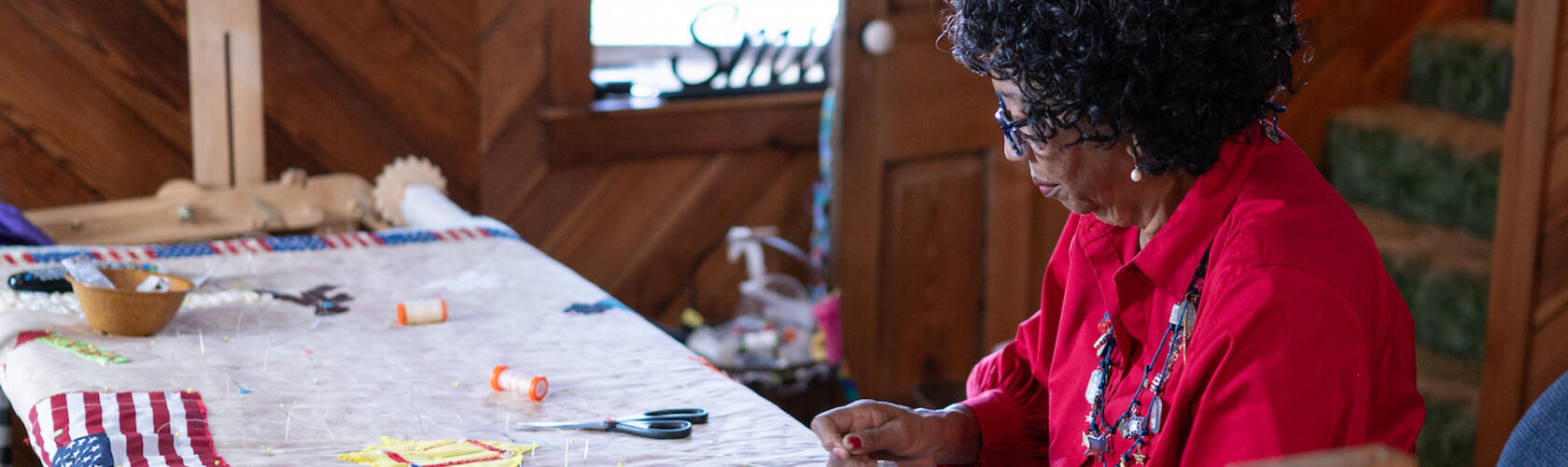
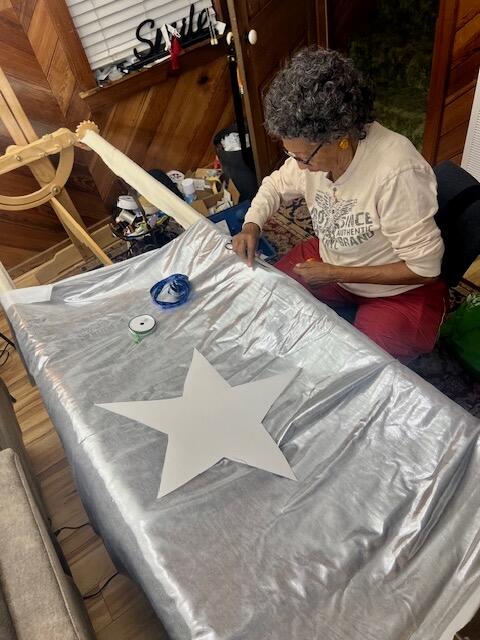
Yvonne Wells assembles fabrics for her new quilt on the floor of her home in Tuscaloosa, Alabama. ‘I talk to the quilt,’ she says, ‘and, believe it or not, it talks back.’ Now 86, Wells began quilting in 1979 out of practical necessity, repurposing her family’s old clothes. Quickly, though, she found that process unsatisfactory. She needed to make quilts that told the stories she could ‘feel in her hand’ and in ‘the stick of the needle’.
Ahead of her solo show with Fort Gansevoort at Frieze Los Angeles, Wells reflects on her playful and poignant movie-stars quilt series, her trunk of materials gathered from garage sales and mysterious boxes left on her porch, and the importance of disorder in the creation of each quilt.
Livia Russell Can you talk about your new work for Frieze Los Angeles?
Yvonne Wells When Maggie [Dougherty] from Fort Gansevoort called and said the gallery wanted to show my movie-stars quilts at Frieze Los Angeles, I was floored. ‘And,’ Maggie said, ‘we want you to make a new quilt.’ I’m working on a quilt of six stars. The number six just came to me. I was looking at it last night, and I said, ‘Yes, when this is done, I’ll start another one of these.’ I’m liking it, it could be a series. I have taken it up and put it down and taken it up several times. But by the due date, it will be ready.
LR Tell me about the materials you are working with for this quilt.
YW I don’t normally buy this kind of material, but because it’s about stars and the Hollywood Walk of Fame, I went out and bought the most expensive fabric. I normally just find fabric in a garage sale or something, but I spent a lot on this, and I don’t have any qualms about that. If what I’ve already purchased doesn’t work, I’ll go out to get something else.
I buy fabric all the time for quilts I’m working on, but there was something special about this piece that I went out for material especially. I may just keep it, you know, and just hang it up and look at it, because it’s a beautiful piece of fabric.
LR Does a quilt’s narrative usually emerge from the materials you find?
YW I go to garage sales and I get a lot of materials from my clothes and my kids’ clothes. I buy a lot and I find a lot. Sometimes, I see a piece of fabric or article of clothing, and it fits right into the quilt I’m working on, it goes exactly with what’s already in my trunk.
I always have to see what I’m going to make first, and then work from there. I don’t use patterns. I just work from my mind, lay it out on the floor and start cutting the shapes. I go with the fabric and what I find. You’d be surprised. Things I have picked out for a piece don’t match once I start to quilt. This green does not match that orange over there, so I take it out and find something else.
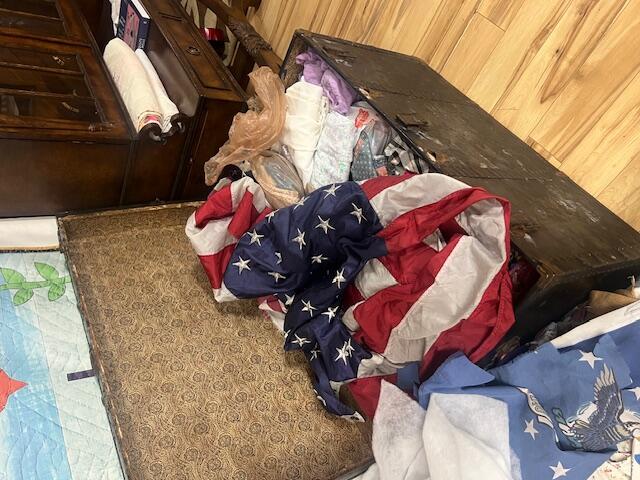
I have a big trunk full of fabric that people have given me. I must have something from every category in the world in that trunk. There are times when I have gone to my front door to find big boxes and bags of fabric on my porch, and I don’t know who left them there. I go through all of it and put it in the trunk.
LR Who are the Hollywood legends in your movie stars quilt series?
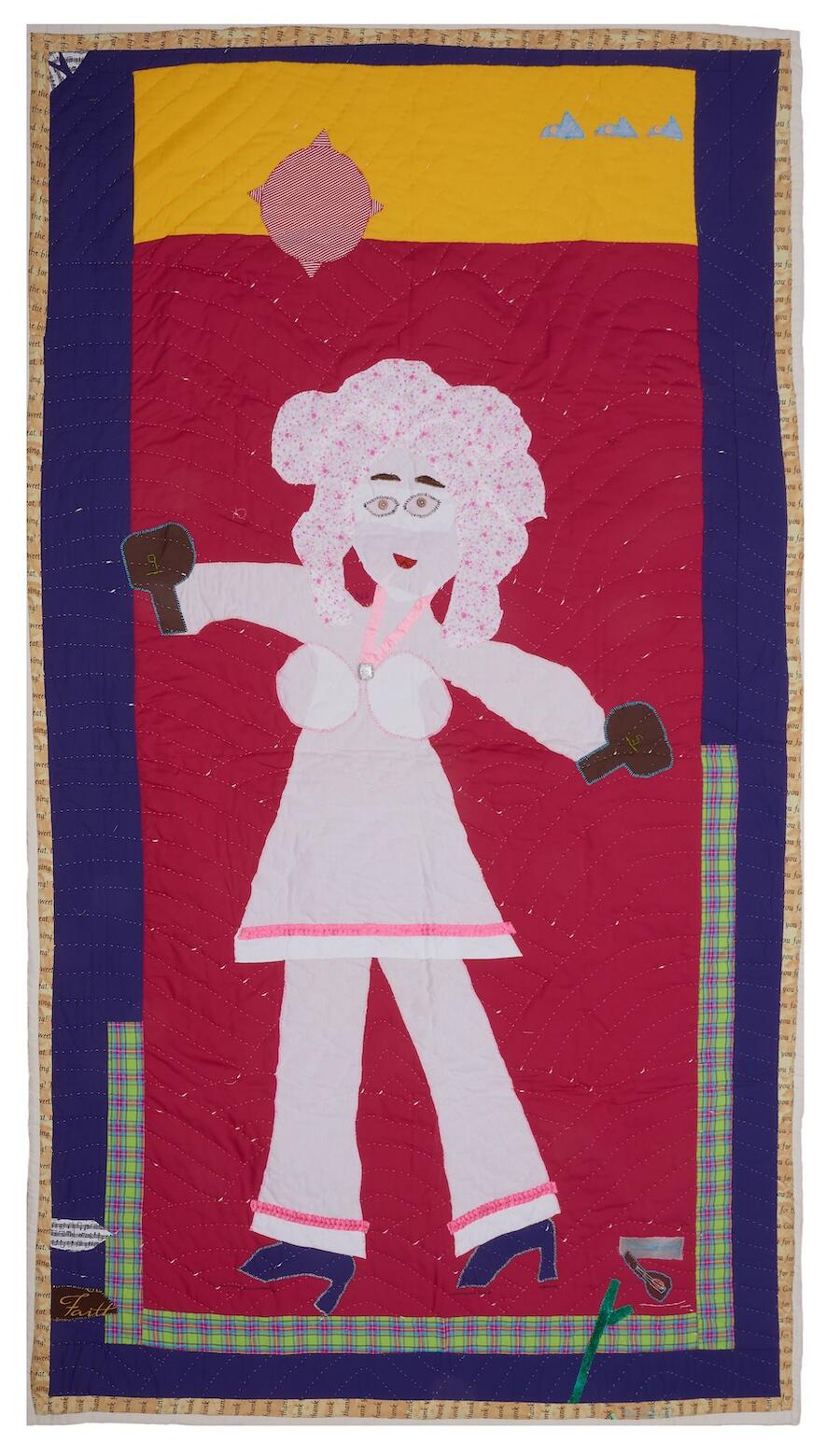
YW Mickey Mouse, Minnie Mouse, Marilyn Monroe, Michael Jackson, Dolly Parton and Elvis Presley. I made these quilts a long time ago, at a time when I was exploring categories.
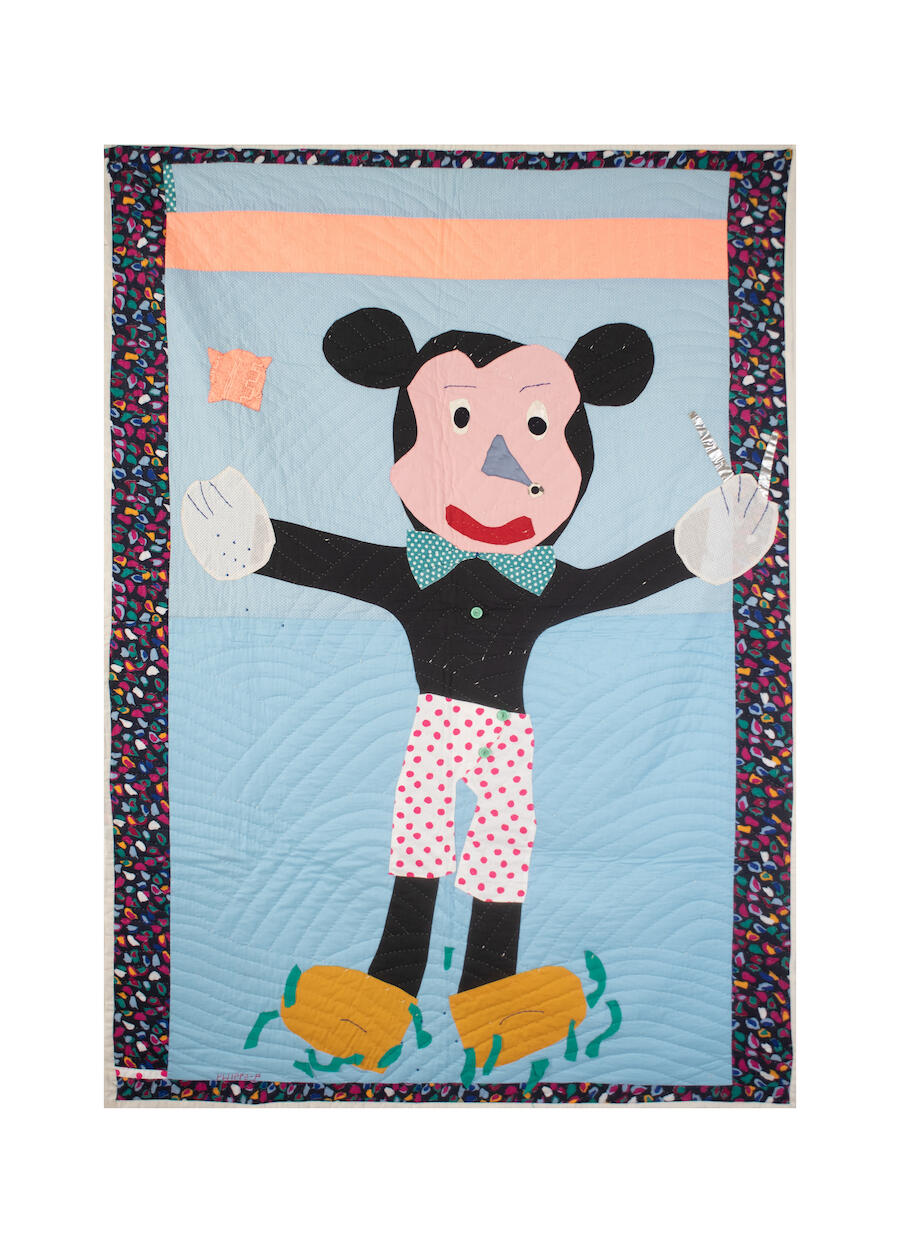
I can’t say for sure if Mickey or Minnie Mouse was first. I believe it was Minnie. I have great-grandkids now, and I made these quilts to show my children that Grandma, Great-Grandma, can make things that they can understand, that they could identify with, so they can appreciate what I’m doing as a quilter.
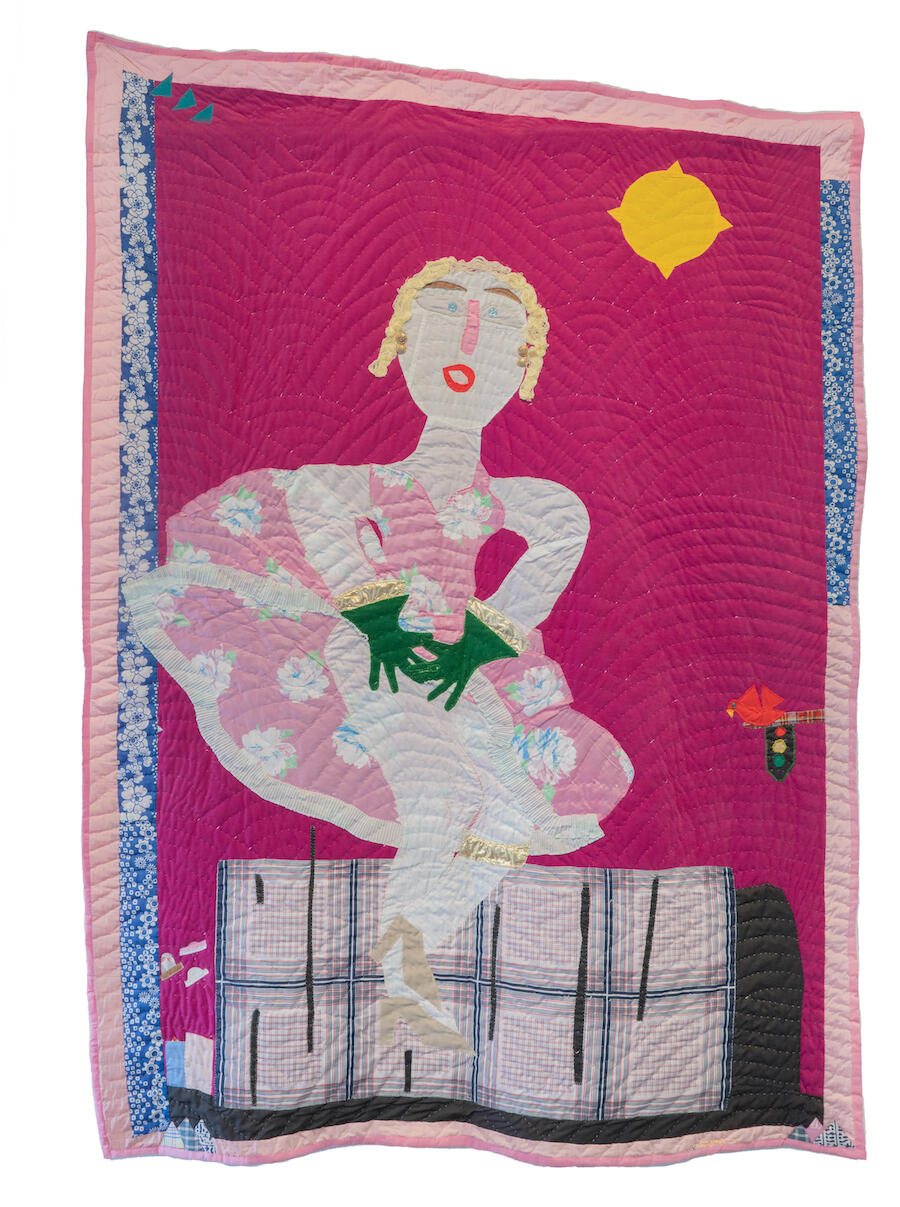
For Marilyn, I always remember that moment of her dress going up and her catching it. So, I put her over a vent in the quilt, with the wind pushing her dress up and her trying to hold it in place.
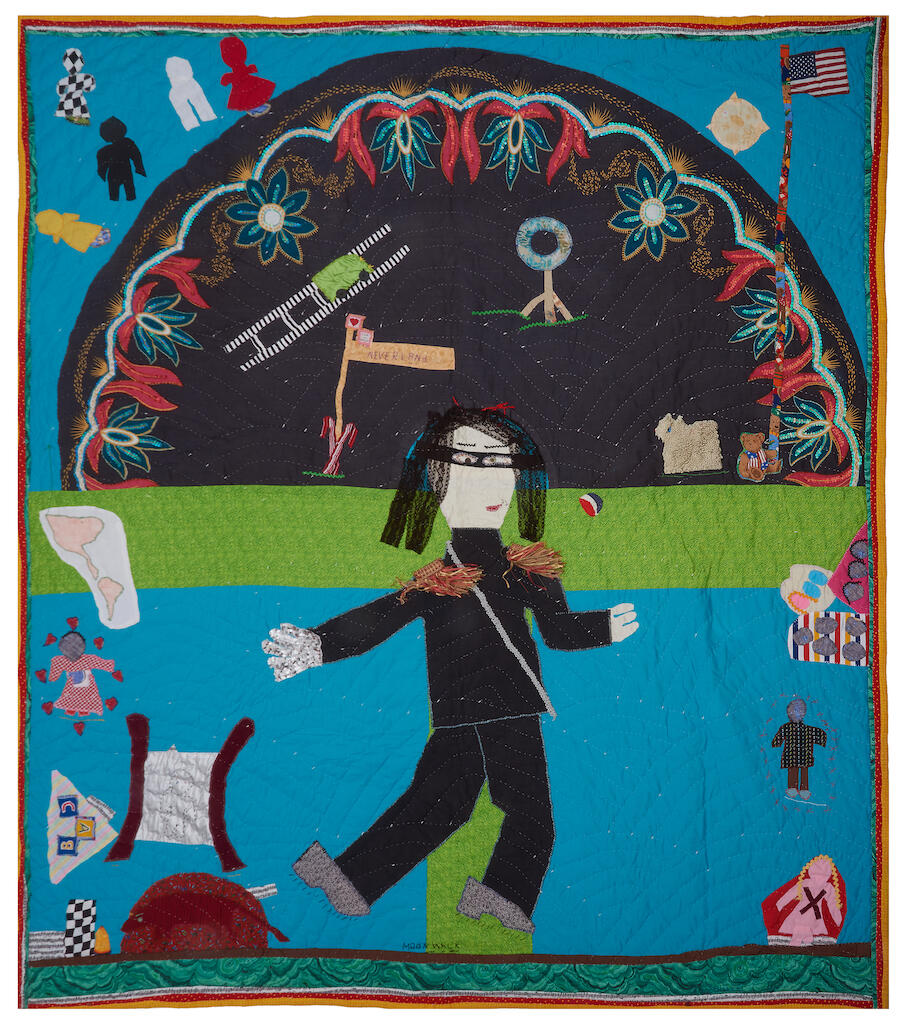
Michael Jackson is doing the moonwalk in his quilt. I remember that he loved his mother, but had a difficult relationship with his father. So, I have them on either side of him in the quilt. I took my brown skirt that I had on, cut it out and made it fit over his head. Around the skirt are the children of the world. It was very close to me.
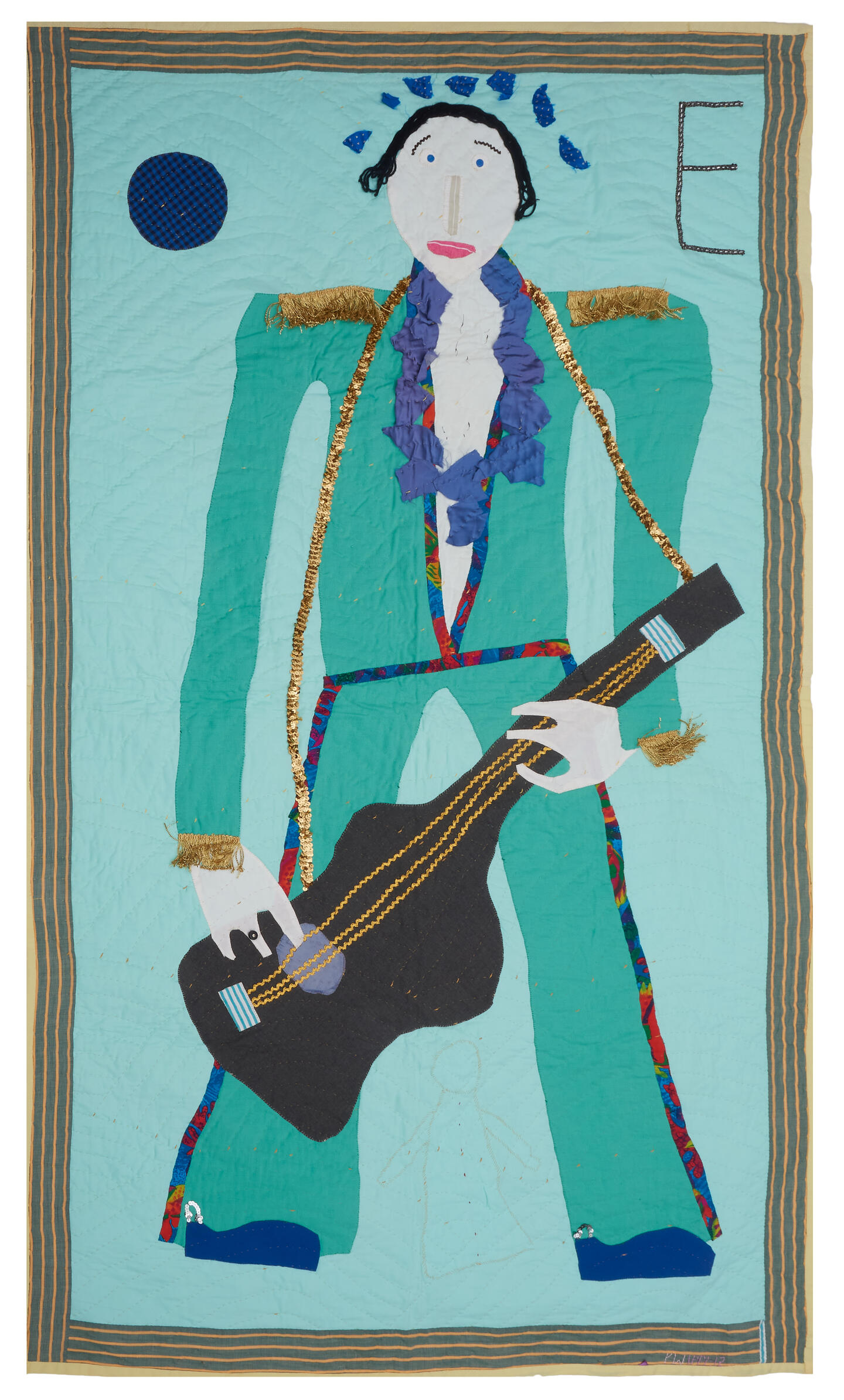
We couldn’t watch television when Elvis was wiggling from the waist down. They would turn it off. A lot of people didn’t care for him, but I did. I’ve made three quilts of him. One in a white suit, one in a pink suit, and one in a green suit. He, too, was very close to his mother, and on one of the quilts, I put his mom standing between his legs because I didn’t have enough space to put her where I thought she should be on the quilt. I was asked, ‘Why between the legs?’ Because I couldn’t find another place suitable. They’re all placed strategically and right. I feel so good about these. I hope the people in Los Angeles will enjoy them. It could be humour or it could be sadness, but they will see a part of me there and I’m excited about that.
Early on, I felt I had to be there with my work to explain it. I thought people needed my narrative to understand the connection between the symbols and the colours. I thought I needed to go and talk about this funny-looking shape, or why this is not a smooth piece of fabric, about what they meant to the story, and then people would understand it better. Now, I don’t do that so readily, because my work has been out there for a long time, and people know what colours and shapes mean.
LR You live and work in the same region as the women quilters of Gee’s Bend, Alabama. How do you relate to their legacy?
YW I think there’s a big disconnect. I think they are fantastic quilters. I enjoy and I appreciate what they do, and I’ve done workshops with them, but that’s not me. I see things in my quilts before I put them down. They piece and I appliqué. There are times when I do cut off a piece of a quilt top that someone has given me and put it in my work to let folks know that I am a quilter.
LR You’ve spoken about the importance of disorganization in your practice. Why is disarray key to the success of a quilt?
YW I’m so glad you can’t go back in my room and see the junk that’s all on the floor. It’s the way I operate. When people come over, they want to come through that door. I can’t let them back in there. This is who I am. I don’t want to be told that I need to straighten this up, get this off the floor, pick up the needles and threads.
Once you see something out of out of order, you can always see something else out of order. If a quilt doesn’t work, I put it down on the floor, and if it still doesn’t work, I throw it back in the trunk, and I’ll use it for something else. I don’t know any other way to make. The more clutter, the more I see.
LR As you move the quilt from floor to frame, what changes?
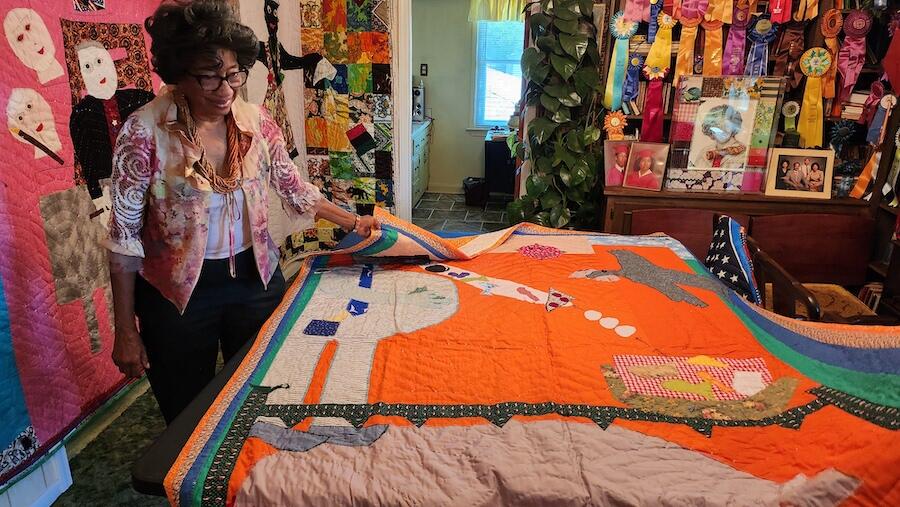
YW I stand over my quilt as I’m in the process. I look at it and talk to it. And believe it or not, it talks back. People say I’m crazy, but that’s okay. If I think that green piece down there is good, I’ll turn around and look at it again, and suddenly it doesn’t look right, and I have to move it out the way. It could be used in something else that’s coming up. Now, I have about four quilts in progress. Sometimes the story sings, it’s poetry, it’s all of that. To me it is, anyway, and I enjoy that immensely.
Not everybody likes folk art. I was told it was junk, to go to school, to learn how to quilt. I just wondered what they were comparing me to. The traditional quilters? It was 1985 when I got that kind of comment, but here I am and it’s 2025. I didn’t listen to them. My message to anybody who’s doing something off the beaten path is to use what you have in your mind to do what you want to, regardless of all the whispers and all the jabs.
LR Is the overlap between domestic and artistic space important to how you work?
YW My husband and my family have always allowed me to do what I want to do. They gave me the freedom not to worry about what they were doing, and if I haven’t cooked because I’m making quilts. They were very hands off.
My husband, before he passed away, would always be back in the room where I’m working. On his side, where he sat and watched TV, everything was as neat as can be, while I was working all over the room. He slept a lot. He had PTSD. I did make something for him once. He went out to the mall and came back with a newspaper with a quilt on it, and said, ‘Can you make this?’ I said, ‘Oh no, I can’t make that.’ And I felt bad because he thought I could, but it was a pieced quilt.
It was a star. That’s strange, we’re talking about stars. I hadn’t realized that until now. I took the newspaper anyway and kept it for a year, and looked at it, and said, ‘I’ve got to make this, because this seems to be kind of close to him.’ So, I barrelled through the process and finally came up with a beautiful star. It looks very much like what he was showing me.
LR You initially made quilts out of practicality before you began making them with an artistic motivation. Tell me about this shift. Do you still feel that moment in how you work today?
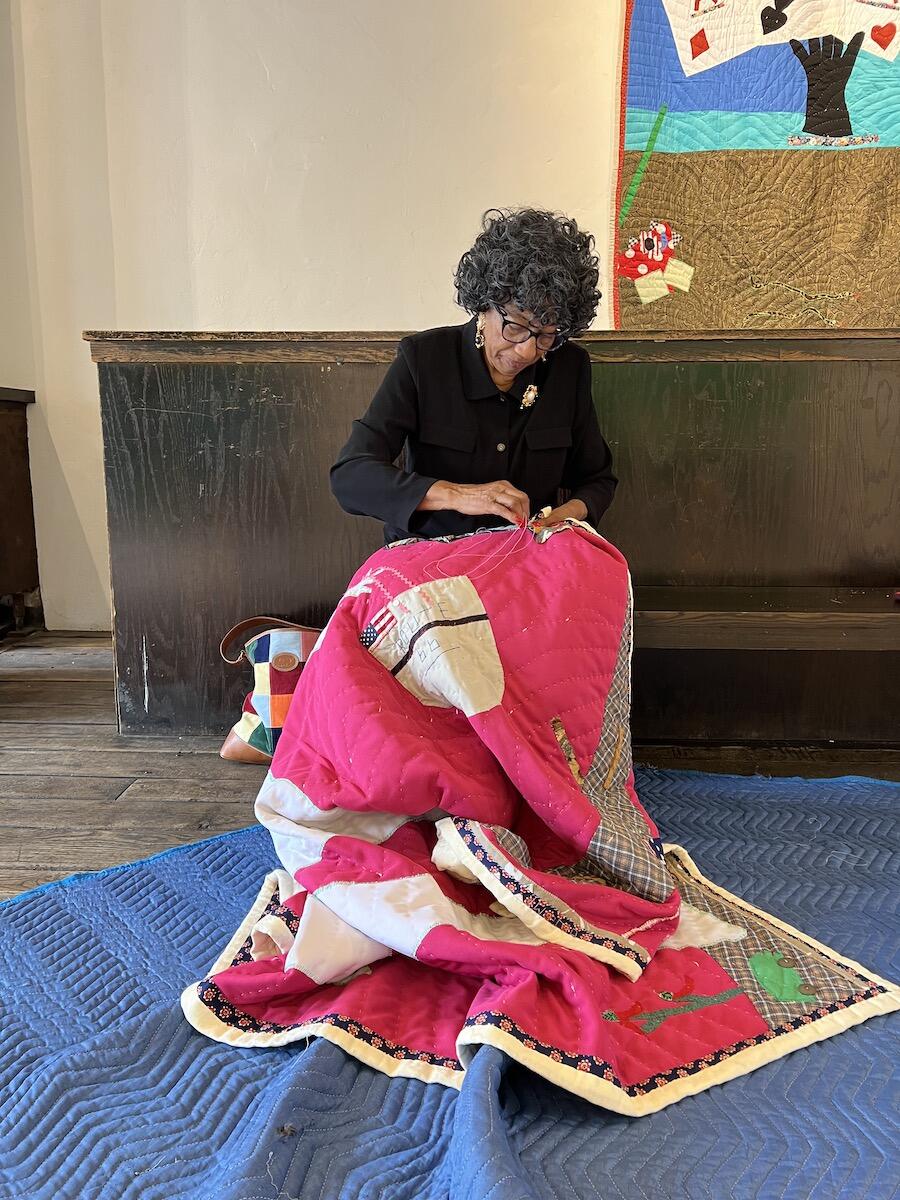
YW I do. I was not making stories when I first started quilting in 1979. I was making a traditional kind of quilt. The materials I needed to quilt were there, hanging on the wall, on my bed, among my children’s clothes. After a while, it was not a satisfactory process. I said, ‘I think I can tell a story. I think I can make something of this.’
I showed my first story quilt to the public in 1985. It was a crucifixion. It looked so good to me. I said, ‘Wait a minute, wait a minute. Let’s just look at it.’ It was so simple, but so powerful. And from then on, I started telling stories. I still am. I have to feel all my stories in my hand. I have to feel the stick of the needle. That’s just who I am.
LR You’ve made more than 900 quilts. If each quilt tells a story, what story do they tell together?
YW In all the quilts that I’ve made, I think together they would say, ‘This is what Yvonne Wells has seen and made from her artistic viewpoint. This is what she thought, and not what other people thought.’
Further Information
Frieze Los Angeles 2026, 26 February – 1 March 2026, Santa Monica Airport.
For all the latest news from Frieze, sign up to the newsletter at frieze.com, and follow @friezeofficial on Instagram and Frieze Official on Facebook.
Main image: Yvonne Wells, 2024. Courtesy: the artist and Fort Gansevoort, New York. Photograph: Sandy Turner