While Germany wakes up this Monday to a new government, Berlin’s art scene – presumably – wakes up to a big hangover after a crazily busy art week in the city. When last Thursday mayor Klaus Wowereit participated in a panel discussion entitled ‘Does Berlin need a Kunsthalle?’ at Hamburger Bahnhof Museum (coinciding with myriad art events in Berlin, including the art fair, ‘art berlin contemporary’, and tonnes of gallery openings), he confirmed his intention to build one. But whether he’ll still be concerned with this question in the near future is the big question after yesterday’s general election in Germany. His party, the Social Democrats, lost by a landslide, and in Berlin – where Wowereit still had a comparatively strong standing – it didn’t fare much better.
Of course there are bigger questions now, with a coalition of Merkel’s conservatives and the liberal party now in power. But in any case Wowereit’s coalition partner in the Berlin senate, the leftist Die Linke, was significantly strengthened, and they don’t favour a Kunsthalle at all, playing it off against other budgetary commitments. On top of that, given the sorry state of the SPD, it might well happen that Wowereit will turn to bigger tasks at the head of the party.
Given that the plan for a Kunsthalle still seems written in the stars more than anywhere else, there seemed to be one agreement though between most of the panellists – including artists Monica Bonvicini, Olafur Eliasson and art critic Niklas Maak of the Frankfurter Allgemeine Zeitung – that a new building, rather than using an existing structure, is the way forward, favouring a more adventurous take on contemporary architecture (and the Humboldthafen, a spot just across from Hamburger Bahnhof, right next to the central train station). The question is whether Maak’s argument against pompous landmark gestures à la the Guggenheim Bilbao, favouring instead structures actually suiting the needs of art (which was also confirmed by Bonvicini and Eliasson), really registered with Wowereit, who hasn’t shown much interest to date in listening to artists or art critics. After the change in the political landscape, this might now happen, in order to boost credibility – or the project will get axed all together.
Meanwhile the Temporäre Kunsthalle – a white cube box built by Viennese architect Adolf Krischanitz – attempts a relaunch after months of struggle. The structure – temporarily established last year in the spot where the Hohenzollern palace is planned to be rebuilt in coming years, and financed almost entirely by one patron, Dieter Rosenkranz – had been used for a string of respectable solo presentations by artists such as Simon Starling or Candice Breitz; but what the programme lacked was a real sense of direction. Maybe that was because it didn’t have a proper director who actually would have some surprising ideas and create a sense of coherence. Instead it had a board of too many advising curators. Now it seems to do better without that board, though still without a proper director; in any case, the concept of asking artists to curate shows could prove more rewarding, starting with a nicely odd show entitled ‘Scorpio’s Garden’ by Danish artist Kirstine Roepstorff that makes good spatial use of sculptural works by Julian Göthe or Isa Genzken (to be followed by a show curated by Karin Sander). The outside skin of the building also has been used in a simple, but effective way by Bettina Pousttchi who turned it into a black-and-white, ghostly distorted Echo of the Palace of the Republic demolished not so long ago, right next to the spot.
(pt. 2 soon, followed by a slightly delayed write-up of recent art events in Stockholm)
Zhang Huan’s studio is about an hours drive outside the centre of Shanghai. ‘Studio’ is actually the wrong word: rather, it’s a compound. A former factory, spread out over several huge buildings. A welding workshop, a carpenter’s workshop, a woodcarving workshop, a huge hall for the assembly and display of huge monumental sculptures, a Kunsthalle-type warehouse space for the display of paintings and smaller sculptures. His own office is small, and very modest. Apparently he has around 60 workers on his payroll. All of which is impressive, and in line with other major Chinese artists who can afford to enlist a lot of assistants based on their international success and the low cost of real estate and labour in China. But it’s also surprising, given that for most of the 1990s and well into the 2000s he was an artist having become famous with work that usually the only medium for was his own body, and the photographic documentation of the performances realized with it.
Zhang Huan is an athletic, soft-spoken, very friendly man with a very intense pair of eyes, and without exaggeration one can say that he no doubt could be an action movie hero (in fact he does have plans for a movie project in the near future, albeit not a genre film). Me and Carol Lu, Beijing-based contributing editor of frieze, met him shortly after his return from Brussels, where he was for the premiere of his staging of Händel’s Semele at the National Opera house. Seeing some images and listening to his description, the project sounds quite fascinating: the starting point was to ship an entire Ming dynasty family temple made of ornate wood to Brussels and put it up on the stage; the second performative-conceptual idea was to ask the widow of a family associated with the temple whose husband had been executed after killing her lover to come to Brussels and wipe the stage with a broom at the beginning and end of the performance. Another temple of the type used in Brussels was put up outside, next to the woodshop; it’s quite weird that these beautiful pieces of architecture are actually up for being taken elsewhere; they’d surely be under preservation in many other parts of the world – though maybe Huan, similarly to Ai Weiwei who also works a lot with old wooden structures, should actually rather be seen as artists who are in the business of preserving rather than destroying these old structures – albeit to their own ends. (Here’s a review of the opera from the Herald Tribune, which complains about Huan’s more radical interventions, which to me sound very much key to what makes his staging interesting.)
At the point when we entered the biggest hall in Zhang Huan’s complex we encountered two huge, Buddha-like heads (one of which was actually rather modeled on the heads of the famous terracotta warriors) made largely of incense stick ashes that Huan’s team collects from the Buddhist temples in the Shanghai area (he also makes large, delicately made paintings based on Mao-era photographs with the material). As the smoke, emanating from the sculptures like from volcanic soil, vanished through an open roof top window, I had to think, even if that is inappropriate, of a film set for a more adventurous King Kong remake. It also became apparent that visiting the studio of a savvy major artist such as Huan is not the kind of ‘oh I was just working on this when you knocked on the door’ kind of experience (even if that in itself of course is often in a sense staged). Rather, it felt like a carefully choreographed tour. With a comic relief after the smokin’ giants’ heads; in the form of a hog that had famously survived for several weeks without food after last year’s terrible earth quake in the central Chinese Sichuan province (here’s the story). Now he just hangs out in a small shed, basically doing nothing, being offered a charitable home by Huan for the rest of its days – though he does work in a sense, since a life camera feeds his image to Huan’s exhibition in London’s White Cube. I guess he’d only need a Miss Piggy to be fully happy again.
Talking about bachelors, there was a funny video piece, back in the city, in what turned out to be the best (group-)show that didn’t take place in one of the big museums, but in a real estate development used interim: ‘History in the Making: Shanghai 1979 – 2009’, curated by Biljana Ciric, is a rewarding, museum-scale, museum-quality exhibition about thirty years of experimental artmaking from the city. (Press release here.) The piece in question was by Lu Chun Sheng, a video showing her walking aimlessly around the streets, continuously looking up as if for UFOs or rare birds, entitled Where are the bachelors?. Other favourites included the early abstract paintings of Yu Youhan, a video documenting a positively bonkers, slapsticky body-performance by the M-group, and a video by Jin Feng retelling real-estate speculation around an industrial building ruin in the centre of Shanghai (it looked like the one located right next to the gallery district) in form of a fairy tale (along the lines of ‘…and then the king decided to give the new land to the peasants…’). Also great was Zhou Xiaohu’s Detective Project – To Chase One’s Tail involving a bunch of private detectives ordered to chase each other, until the last one hired chases the first one, thus creating a snake biting its tail (shown in the form of a circular cctv installation). If you happen to visit Shanghai before 10 October, don’t miss that show.
Watch out for a Stockholm report soon to come.
P.S. (thank’s to Colin Chinnery, Paul Peronnin and Anton Vidokles for being such great hosts)
Artist Xu Zhen currently is the top dog in the Shanghai art scene, an energetic young artist bound to play the game of a media-savvy eclecticist who doesn’t shy back from any displays of frivolously ironic conceptualism and cynical provocation. He’s working under several aliases now, and also runs a website. But his show at Beijing’s Long March Space last Winter also exposed the shortcomings of his game: the mother of a Guinean toddler was paid for her daughter to appear in a gallery scenario including an animatronic vulture, recreating the infamous 1994 photograph of a starving Sudanese baby girl stalked by a real vulture (a video version was shown in Basel’s Art Unlimited this June). Layering levels of voyeurism, exploitation and shock on top of the ones already associated with the original photo does nothing to actually allow political or aesthetic insight – it just serves to create, so to speak, the animatronic imitation of an actual debate. Where censorship and a lack of platforms for critical exchange prevent this debate from happening, this kind of stuff fills the void. Just compare Xu Zhen’s piece to Alfred Jaar’s The Sound of Silence of 1995: the latter’s is a filmic-textual essay set in a kind of choreographed installation, based on the story of the same photograph, also working with shock and voyeurism. Jaar shows you the original photograph, combined with a blinding flash of lights, as if burning it into your brain tissue. He’s not however out to just feed on the shock value and heightening it in terms of exploiting yet another person (and by way of that making the exhibition visitor an unwillingly complicit as well), but actually creates a thought-provoking collision of political engagement, ethical guilt, and aesthetic analysis.
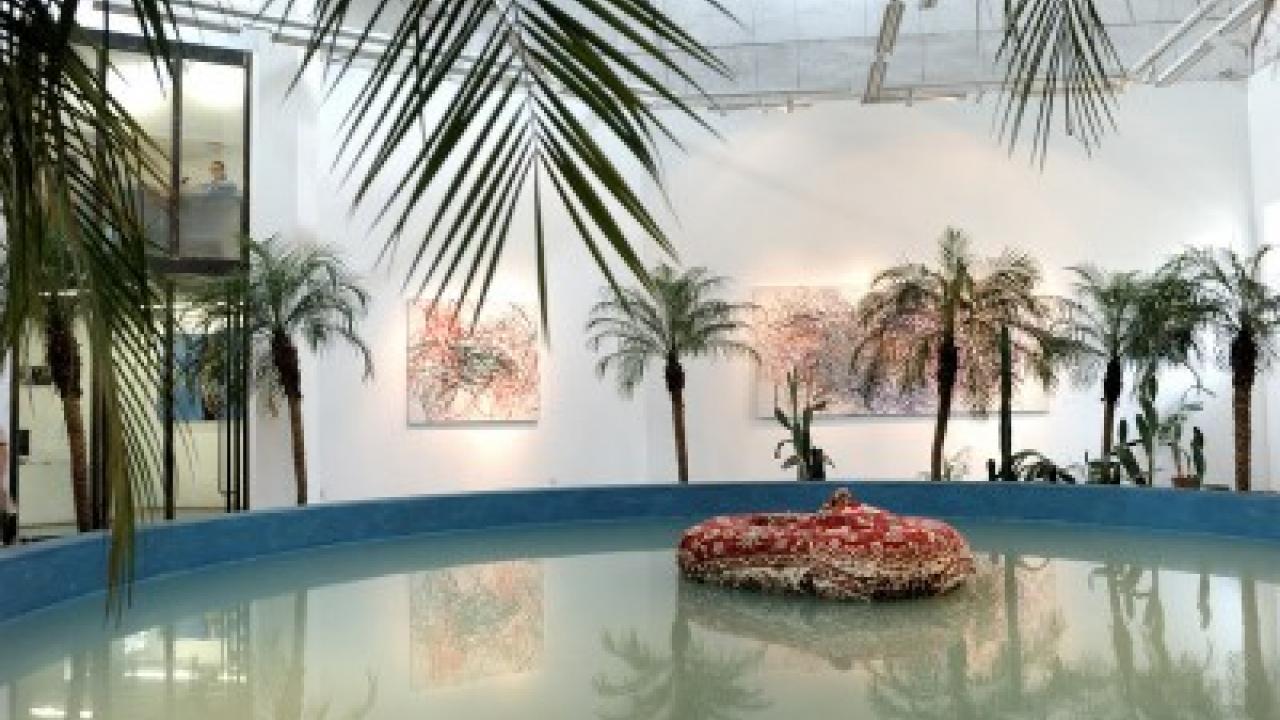
I could go on but back to Shanghai: here, Xu Zhen – having renamed himself into an artistic entity called ‘MadeIn’ – dominated the central hall of the ShContemporary Discoveries section with what seemed a piss-take of the typical Expo or Olympics sculpture involving fake grass, decorative columns and odd mannequins – but again one couldn’t help but think that he fed on the logic of hugeness rather than deflating it. Even more ambitious was his show at Shangart Gallery, spread over several spaces. Again authored under the alias ‘MadeIn’, he created a fake group show displaying works of Mid-Eastern artists. And again he pulled the registers on the pipe organ of grand gestures, and pushed the usual buttons: one space is a swimming pool with doodled paintings placed around it, another space features Styrofoam pieces reminiscent of the kind of bulky packaging material used for TV sets etc. But here, the cut-outs are not for home entertainment but for miniature mosques and life-size machine guns. As said, the usual buttons. There is also a miniature oil well pump made of barbed wire.
Rumours abound that supposedly the show was threatened with being closed due to diplomatic concerns and/or, simply, censorship, but one can’t help but think that that is yet another button being pushed. Even if true, how frustrating it must be if one feels obliged to show solidarity with a censored artist or writer whose work one otherwise isn’t necessarily convinced of. All of that said, Xu Zhen remains an active force in Shanghai, and there are certainly more, and possibly better, things to come (Hans-Ulrich Obrist, for that matter, in conversation said something along these lines).
The most talked-about group show was ‘Bourgeoisified Proletariat’, organised in a new building, the Songjiang Creative Studio, on the outskirts of Shanghai, just across from Ikea (press release here). Everything, not necessarily in a bad way, looked slightly improvised, although the show included large ambitious installations. And – surprise, surprise – a certain ‘MadeIn’ was listed as one of the co-curators, and one of the artists in the show. Here, Mr. ‘MadeIn’ created a disco-space with a huge dopamine-molecule in the middle entitled Love in Fact Results from an Excess of Dopamine in the Brain (2009), plus all sorts of (English) sentences on the floor made of necklace chains (_Metal Language_, 2009), including banal stuff such as ‘did you bring the DVDs I asked you’ next to more implicational-sounding ones such as ‘job what job?’ But what got us more talking on the way back in the car was Kan Xuan’s sound installation Dead, which we all felt wasn’t maybe 100% fully convincingly realized on the aesthetic-technical level, and certainly also we didn’t fully understand (where were the sources from, what was it really about?), but in any case the screams and voices in it created a haunting sense of urgency. Same for Zhang Peili’s Unnecessary Collision (2009), an installation involving two bones clashing through a remote-controlled mechanism, accompanied by a literally bone-shaking sound. This may sound wannabe-spooky, but was in the best sense deadpan. (Peili is a super-important veteran of Video art in China, and is heading the leading video department at the China Art Academy of Hangzhou.) Yang Fudong’s video installation My Heart was Touched Last Year (2007) involved two glamorous-looking (Shanghai?) ladies looking at the camera on two screens in separate rooms, back to back. In both scenes the punch line was that they never, by way of editing manipulation, blinked. A bit too one-liner for my taste, but others liked the piece.
Third and last postcard from Shanghai will include a studio visit with Zhang Huan, who is more than just a sort of hardcore no-nonsense forerunner to Xu Zhen, and a short discussion of the best group show currently on show in Shanghai, ‘History in the Making: Shanghai 1979-2009’. Bear with me.
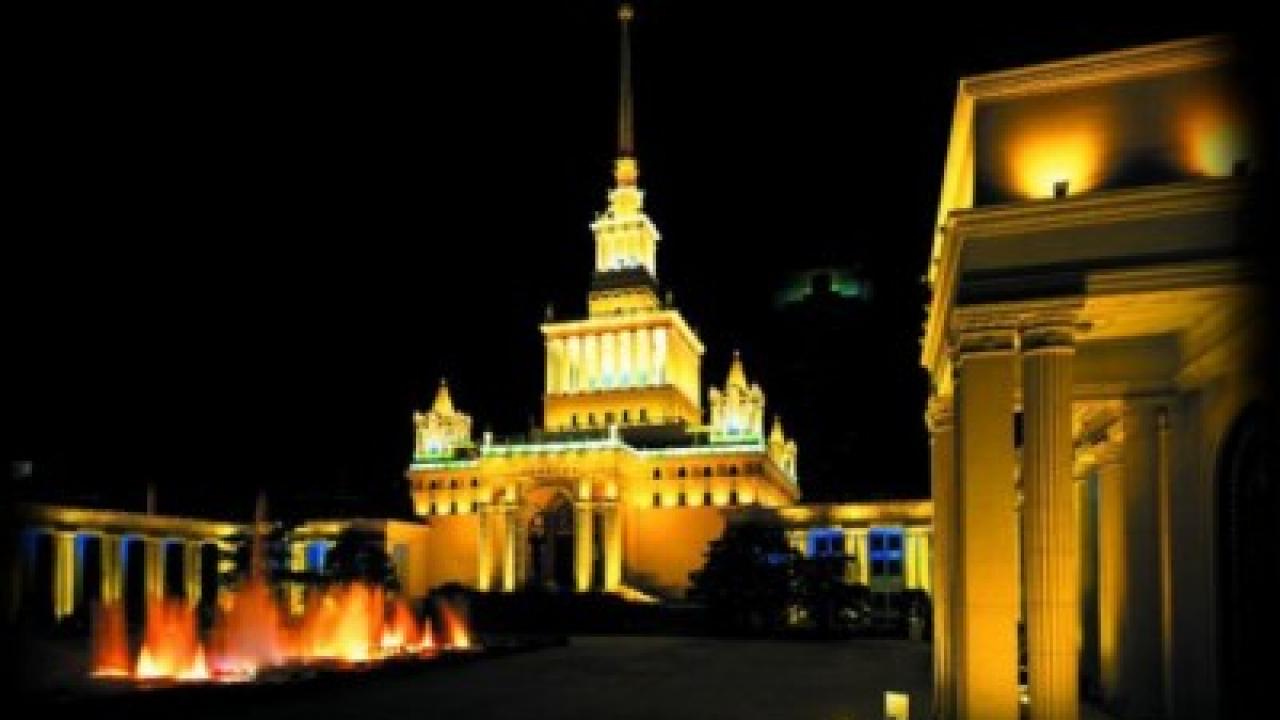
Almost literally the first person I ran into when I arrived in Shanghai was Boris Groys. It couldn’t have been anyone better when it came to chat about the building where the SH Contemporary art fair is housed (Groys and I, along with other speakers, had been invited by Anton Vidokle of e-flux to participate in a lecture series there): The Shanghai Exhibition Center is a huge complex that was a gift by Stalinist Soviet Union to Maoist China; it’s a pompous birthday cake, a communist Disney palace, typical of that era with its sugary toppings on the roofs and its flowery ornaments in unexpected places. Oddly, but maybe appropriately, the central grand entrance of the building was actually not used as an entrance (one entered less grandly through the vestibules). Groys said he wondered why no-one seemed to want to make use of the pomp of the place by putting up, say, ridiculously large Jeff Koons sculptures. It’s the kind of suggestion that makes sense coming from an expert of Stalinism such as Groys; but it also made sense to me – irrespective of the particular sensibilities of the organisers of the fair – that in today’s China things are played in a bit more of a kind of restrained way even when they are big. This is not about the Protestant concept of stealth wealth, i.e. expensive labels that don’t display labels, money only detectable for those in the know etc. – in Shanghai, of course, wealth is anything but stealth. (I passed by a night club that had, I presume in the course of a promotional event, two Lamborghini sports cars placed on each side of the entrance.) No, in general terms, this is rather about a kind of regiment that works with silent structural implementation rather than open confrontation. The logo for the Shanghai World Expo 2010 is a small, really silly mascot called ‘Haibao’ that according to the official website, is ‘created from a Chinese character meaning people’, embodying ‘the character of Chinese culture.’
It’s this kind of cuteism that feels stealth. It’s something that you sense once you try to go online. I didn’t get that other notoriously cute mascot on my screen of course – the little police officer that appears on screens of Internet users in Shenzhen, southern China.
But even without it, you sense the presence of the Great Firewall: Google image search works for a couple of minutes but then it’s usually interrupted; anything with the word ‘blog’ (or wordpress) in the URL-name is usually blocked right away. Of course there are ways to circumvent that, you can use proxy servers or a paid VPN connection to a server outside China; but obviously that whole business is tedious – and is meant to be.
That said, the very real presence of censorship in China – pages demanded to be torn out of art magazines, works not allowed to be hung, often for silly reasons such as supposed pornographic display – can also become part of an exaggerated logic of paranoia, which in turn can be fuelled into art world hype. The case of Ai Weiwei being beaten up by policemen, according to the available sources, is all too real to be taken for merely self-promotion; but one can be suspicious a little when rumours abound that supposedly Xu Zhen’s show at Shangart Gallery was threatened to be closed. But more about that soon in part two.
‘I’m playing the role of a little old lady telling her life story.’ So begins The Beaches of Agnès, Agnès Varda’s whimsical and lovely autobiographical documentary, which is released in the UK on 2 October. (Varda will be talking about her life and work at 5.00pm on Saturday 17 October as part of Frieze Talks 2009.)
Addressing the camera or watching on while childhood scenes are playfully re-enacted, the 80-year-old filmmaker visits locations from her life – both filmed and private – as the memoir shifts between archival footage (unfinished early projects as well as her better-known films) and gentle flights of fancy involving family and friends.
Though roughly chronological, The Beaches of Agnès proceeds via these loose associations, circling around the several beaches that Varda sees her life as returning to – from the Belgian seaside of her childhood (Varda was christened Arlette after Arles, the town in which she was conceived, though changed her name at 18); Venice Beach, California where she lived with her husband, the director Jacques Demy, between 1967 and 1977; and Paris, where a streetside beach is fabricated in lieu of an actual coastline. One of the film’s many joys is the way in which the films of her contemporaries are interspersed – Demy (who is a palpable though largely silent presence throughout), Jean-Luc Godard, Alain Resnais and Varda’s ‘friend and interlocutor’ Chris Marker. The latter, whose preoccupations with time and the lure of images is the clearest equivalent for the film’s technique, is represented by an orange cartoon cat – I’m guessing an in-joke about his 2004 film The Case of the Grinning Cat.
In a Q&A following a screening of the film in London on Monday evening, Varda discussed how she has always seen memory as a process of slow fragmentation. Though playful in approach – props are often little more than cardboard cut-outs – the film’s retrospective gaze deals with both the horror of forgetting and living on through celluloid. ‘While I live, I remember’, Varda states simply, towards the end of the film. Wise and uninhibited, she’s also an entertaining speaker – when asked why, exactly, she changed her name, Varda said: ‘All names that end with “-ette” I think are ridiculous. If I had been conceived in London I’d have been called Londonette or something…’
Varda showed at the Venice Biennale in 2003 and, more recently, at the Fondation Cartier; though she refers to herself as ‘a young artist and an old filmmaker’, presenting work in an exhibition context is a kind of return for Varda, who spent her 20s more involved with art than with film (after having studied art history at the Louvre, an early job was photographing and retouching Rodin sculptures). However, when asked whether she now considers herself more artist than filmmaker, she responded drily: ‘My first film was in 1954. I’ve been making films for 55 years – I think I’m a filmmaker, non?’