I went to Shanghai on the occasion of ‘The Last Two Decades Revisited’, which was the public lecture and discussion programme for the exhibition ‘Double Infinity’. The show that engaged Asian and European artists to create works in response to a selection of art works from the collection of the Van Abbemuseum was a joint effort between the Van Abbemuseum and Arthub Asia that took place from April 29 to May 23 at the Dutch Culture Centre in Shanghai, as a satellite event to Holland’s participation in the World Expo 2010. To activate a collection, archival materials and past memories through commissioning new works and initiating conversations surrounding their collection is very much in line with Van Abbemuseum’s past and present programmes such as Plug In and Play Van Abbe, the latter of which is currently running in the museum for 18 months. The two-day public programme on May 15th and 16th brought together Chinese and international artists, critics, theoreticians and art historians to question the given accounts of Chinese art history. This was a timely and necessary discussion in light of the current phenomenon of staging exhibitions with a historical claim in Beijing and Shanghai. The beginning of May just saw the opening of Reshaping History in Beijing, a rather extensive survey of Chinese art produced in the last decade comprising over a thousand pieces of works by more than 200 contemporary Chinese artists. The show triggered a great deal of controversy as it turned out to be an occasion that clearly favored quantity over quality, power play over respect for art, tacky sensation over thoughtful treatment of ideas.
Despite their grandiose ambitions, most of these attempts at establishing historic accounts ended up repeating the same simplified chronology that has been overexposed rather than carefully examined. On April 18, Minsheng Art Museum was officially opened with a 30-year survey of Chinese paintings from 1979 to 2009. Minsheng Art Museum is the latest addition to the roster of private art museums mushrooming in Shanghai in the past few years. Most of these museums are supported by private enterprises from property developers to private banks and they constitute a unique part of the institutional scene in the city. Shanghai artist Zhou Tiehai, vice director of the Minsheng Art Museum and curator of the exhibition walked us through the nearly 100 paintings by more than 80 artists that are on view until July 18th. Apart from the usual suspects, a few of the names are no longer familiar today but were relevant to the art scene of the former decades. The show wasn’t organized strictly chronologically but evolved organically taking into accounts of the manifold associations among the works in terms of their conceptual, stylistic, aesthetic, and mostly relational relevance and legacy. It was overall a tasteful selection yet as a statement for 30 years of Chinese contemporary art as it aspired to be, such a personal, intuitive and loosely constructed narrative left ample room for in-depth research and theoretical discussions.
Just a few days before my visit, Biljana Ciric, a Serbian curator based in Shanghai, launched her Chinese language publication ‘History in Making: Shanghai 1979–2009’ on May 11 in Art House in Shanghai. The publication was an archive of interviews with artists and documents collected from her research for an exhibition of the same title that was opened last September. Along with this exhibition, the publication revealed many lesser known but important facts, practices, and thinking in the current circulation of knowledge about the art history in Shanghai.
Rock Bund Art Museum is another new venue in town for contemporary art that opened on May 7th with Cai Guo-Qiang’s solo exhibition: ‘Peasant Da Vincis’. The museum is housed in the handsome Royal Asiatic Society building, a site of historic heritage completed in 1932 and formally a museum that collected natural specimens and cultural artifacts, with a recently renovated interior. In a recent interview with Hi Art, a Chinese art monthly magazine, Cai has said that he’s done with those government-level commissions of choreographing firework displays for the Olympics or the 60th National Day Celebration of China and is now turning his attention to the common people.
This inaugural exhibition of the Rock Bund Art Museum claimed to celebrate and showcase the creativity of Chinese farmers and presented a number of makeshift mechanical inventions by peasants discovered by Cai Guo-Qiang from all over the country, among them, airplanes, helicopters, flying saucers, submarines, racing cars and robots. The peasant inventors had impressed Cai with their unbound imagination and dedication to carry on their dreams sometimes at the risk of their own livelihood and even lives. One of them died at a test fly of his homemade plane. While these inventions with rather unassuming appearances bear inspiring stories of these individuals who have invested their interest, time, energy, dreams and often scarce resources into these creations, it remained questionable to me whether these projects and aspirations really belonged there in the museum but more importantly how genuine was Cai’s glorification of these common people and how convincing was his emphasis on the power of peasants, who are among the most underprivileged and vulnerable of our society. Although I am not against appropriation strategies and ‘relational’ approaches in which other practitioners – be they ‘hobby’ or ‘professional’ – are incorporated into the artist’s work, I especially question Cai’s motivation to temporarily lift these peasants from their own lives and grant them such a possibility for their creations to be seen in the context of the art museum for the sake of his own practice. We will probably never know what would happen to these farmers and their lives after this small adventure and detour. Cai has positioned himself as a discoverer, collector and owner of these inventions and thus the dreams of these farmers. He had the means, privilege and authority as an artist to place them in a museum and turn the display of these machines into an art project of his own. Cai also organized a series of lectures and conferences organized in association with the exhibition to address and recognize the imagination and creative power of Chinese farmers. There were also large banners and graffiti writings on the surrounding walls outside the museum with sentences such as ‘What Matters Isn’t Whether It Could Take Off’ and ‘Peasants-Making a better city, a better life’, echoing the theme of the 2010 World Expo: ‘Better City, Better Life’.
Back to the city where most peasant workers whose hard labor have been responsible for all the constructions and radical transformations of Chinese cities since the 1990s, had been kept out of sight for the duration of the World Expo, one wonders whether an exhibition like Cai’s has made Chinese peasants seem more present or less in control of where they can be.
As director Apichatpong Weerasethakul takes the Palme d’Or at Cannes this year for his film Uncle Boonmee Who Can Recall His Past Lives it seems like an apt moment to mention a recent spat that has had certain film critics lobbing handfuls of organic flapjack at each other across the auditoriums of their local art-house uniplexes.
This critical storm-in-a-teacup began with the April edition of the UK film magazine Sight and Sound, when editor Nick James took issue with the ‘critical orthodoxy’ of what is called by some ‘Slow Cinema’. It’s a term that has been applied the work of directors such as Pedro Costa, Jia Zhang-ke, Carlos Reygadas, Aleksandr Sokurov, Bela Tarr, Tsai Ming-Liang, and, of course, Weerasethakul; a form of cinema which critic Jonathan Romney has described as a ‘varied strain of austere minimalist cinema that has thrived internationally over the past ten years […] a cinema that downplays event in favour of mood, evocativeness and an intensified sense of temporality’.
Apichatpong Weerasethakul, Uncle Boonmee Who Can Recall His Past Lives, 2010
With the cab driver-esque ‘now, don’t get me wrong or nuffink…’ caveat that he admires and enjoys ‘a good many’ films of this kind, James goes on to wonder whether such films ‘are easy to remember and discuss in detail because the details are so few.’ He writes: ‘the bargain the newer variety of slow films seem to impose on the viewer is simple: it’s up to you to draw on your stoic patience and the fascination in your gaze, in case you miss a masterpiece.’ James makes the argument that in the case of films such as Semi Kaplanoglu’s Honey (which won the Golden Bear in Berlin this year), ‘there are times, as you watch someone trudge up yet another woodland path, when you feel an implicit threat: admit you’re bored and you’re a philistine.’ He contends that ‘such films are passive-aggressive in that they demand great swathes of our precious time to achieve quite fleeting and slender aesthetic and political effects’ and tails off with a somewhat non-committal ‘sometimes it’s worth it, sometimes not.’
James’ editorial has particularly upset Harry Tuttle [1], who runs the blog Unspoken Cinema. Tuttle prefers the working term ‘Contemporary Contemplative Cinema’ (CCC) to ‘Slow Cinema’, and outlines what he considers its salient features to be here and here. In short, he identifies the trademarks to be ‘plotlessness’, ‘wordlessness’, ‘slowness’ and ‘alienation’.
Tuttle is a fervent fan and vociferous defender of this cinematic aesthetic. ‘Typical. Misunderstanding CCC. Looking down on art cinema’ begins his heated rebuttle of James – the first of many, as he gamely takes on other writers who also picked up on the Sight and Sound editorial (notably, Steven Shaviro and Vadim Rizov). He lambasts James’ use of the term ‘Slow Cinema’ since it ‘is a mischaracterisation that induces contempt and caricature. Limiting this cinema to “slowness” is reductive and superficial. This is precisely because unhappy viewers remain on the surface of these films that they are unable to obtain any substance from them. [sic]’ Tuttle hits back at James’ assertion that ‘details are few in these films’: ‘“Details are few” says he! It’s not because you can hardly fill a half-page with plot points and characters arc [sic], or because the list of notable features appearing on the screen is short, that there isn’t anything else there to see. Critics need to learn how to name (and list) things that are not obvious, to learn to find the content behind the appearance of emptiness, to learn to understand the depth and complexity in the intervals between the apparent (nominal) details.’ At one point Tuttle argues that ‘It’s like dismissing Kasimir Malevich or Yves Klein because there isn’t enough [sic] “details” on the canvas… sometimes Art is not about WHAT is represented, but about what is NOT represented, or an abstract reflection on the effect of representational minimalism’. ‘I thought critics assimilated this breakthrough of non-figurative art long time ago!’ he scalds. Tuttle sees James’ editorial as a betrayal: ‘Real film critics giving up on art … Who is going to defend real culture then?’ he asks, ignoring the question here of who gets to say what ‘real culture’ is.
Sharon Lockhart, Lunch Break, 2008
If we’re talking about that which is not represented, Tuttle’s spat with James, Rizov, Shaviro et al is an interesting one partly because of another area of filmmaking that the row itself ignores. Ideas of duration, non-representation, anti-narrative, and such like, have been in circulation in film and video art and shown in galleries and museums since at least the 1960s. Much as I admire Tuttle’s spirited engagement with his favoured genre of contemporary cinema, nowhere on his timeline of CCC/Slow Cinema is there anything that represents, for instance, the achievements of Structural cinema. This is curious, for if ‘plotlessness’, ‘wordlessness’, ‘slowness’ and ‘alienation’ are what he is trying to chronicle, where are Andy Warhol’s Empire, from 1964, or Michael Snow’s 1967 film Wavelength for example? Nor is there any acknowledgement of how these multiple strands of experimental cinema history have fed into the work of artists today. Here are a few examples off the top of my head. Take Sharon Lockhart’s Lunch Break (2008), a lengthy, single-take tracking shot of workers at lunch in an ironworks. Lunch Break has been screened at a number of film festivals, but has not sprung from the ‘default international style’ (as Shaviro puts it, or as Tuttle prefers, an ‘unorganized transnational aesthetic convergence’) of CCC/Slow Cinema but has developed by and large with the support of art galleries and institutions rather than conventional sources of ‘art film’ funding and circuits of distribution. Or look at the films of Tacita Dean: unabashedly langorous and ‘contemplative’, and exhibited widely across the world, though, for whatever reasons, relatively unfamiliar on the repertory ‘art house’ cinema circuit. And how about Matthew Barney’s ‘Cremaster’ cycle (1994–2002), which is currently enjoying a high-profile re-run at the IFC cinema in New York? The ‘Cremaster’ films are extremely long, extremely slow and feature next to no dialogue whatsoever, but, whether you like their dense symbolism or not, you could hardly say they lack details, unless you consider vintage cars destroying the lobby of the Chrysler building and a Victorian satyr burrowing under the Isle of Man to be minor visual asides. Barney, Dean and Lockhart have all been making work since the early- to mid-1990s; far longer than the ten years Romney puts on CCC/Slow Cinema.
Tacita Dean, Craneway Event, 2009
The CCC/Slow Cinema disagreement reveals an interesting myopia, one that is exacerbated by the differing modes of cinema distribution and art exhibitions, and the beaten paths along which film critics and art critics ply their trades. It suggests a state of affairs in which you might be familiar with Douglas Gordon’s 24 Hour Psycho (1993) and Jacques Rivette’s 12 hour-long Out 1 (1971), but for some reason can’t accommodate the different contexts they come from in the same stream of critical discussion. James’ fear of being called a philistine, of admitting that a film that falls into the CCC/Slow Cinema genre is boring, suggests that he’s new to ideas of duration or silence in filmmaking – something I find pretty hard to believe. (This cuts both ways: I’ve lost count of the number of artist’s films [2] I’ve seen that have been lauded for their high quality production values and the fact they use – gasp! – actors and scripts, as if no one had ever done this before.) It reminds me of anxieties one hears people voicing about contemporary art: the fear – instilled in them for whatever reasons of education, background or personal insecurity – that if they say they don’t like something, they’ll be thought of as culturally ignorant. The flipside of this is, of course, the fear of being branded pretentious.
In The Guardian newspaper’s coverage of the CCC/Slow Cinema dispute, Danny Leigh asks ‘is it OK to be a film philistine?’ Framing the discussion along this axis of philistinism and pretension is frustratingly unhelpful, as it keeps discussion mired in very basic terms of class and taste, and elitism versus populism, pushing into the background any other possible forms of analysis of why you think the way a director has put images and sound together is engaging or not. It foregrounds insecurity; the critic or viewer’s anxieties over what other people will think of them and their opinion. Yet Tuttle’s approach doesn’t help either. It interesting to note how at least two of his definitions of CCC/Slow Cinema are formed in opposition to conventional formulations of cinema – ‘plotlessness’ as opposed to plot, ‘wordlessness’ as opposed to dialogue. Why not ‘silence’ rather than ‘wordlessness’ – that is to say, why not foreground what does exist rather than what it lacks? The danger with binaries formulated around the absence of something is that, just like the philistine/pretentious axis, they can hobble the terms of discussion. In this case such absence pits these CCC/Slow Cinema films against a normative model of filmmaking, namely ‘Hollywood’, and all that word is conventionally taken to represent in terms of money, power and cultural hegemony. This can be disempowering in that not only does it slow the development of a critical vocabulary specific to the films in question, but it also situates the discussion within just the same basic elitist-versus-populist framework as philistinism and pretentiousness. (The reductive term ‘Slow Cinema’ does something similar in that the word ‘slow’ implies that it exists in a kind of ideological opposition to a ‘normal’ or ‘fast’ speed of cinema – an effect emphasized by its echoes of ‘slow food’ and that movement’s focus on localism and anti-big business – although the solemn mouthful ‘Contemporary Contemplative Cinema’ is hardly preferable.)
‘Sometimes it’s worth it, sometimes not’: banal though James’ statement may be, I don’t think his admission that he finds certain aspects of CCC/Slow Cinema to be frustrating is that troubling. What can be inferred from his editorial is that a certain approach to filmmaking has its mannerist practitioners; I can’t quite see how one might leap from that to the conviction that Sight and Sound will from now on be giving over their pages exclusively to Clash of the Titans and the Iron Man franchise. The idea that if you criticize some of these CCC/Slow Cinema films you must therefore be craving all-action blockbuster movies is a little like saying just because you don’t like pasta you must therefore love dim sum; personally, I love both, but I wouldn’t want to eat either every day of the week.
2 In conversation the other night, a friend made an observation about the use of the prefix ‘artists’’ – as in ‘artists’ film’, ‘artists’ book’, ‘artists’ band’ or ‘artists’ cupcake recipe’. He pointed out that it acts either as a label denoting exemplary status – ‘this thing is special and doesn’t follow the usual rules of whatever genre it is working in’ – or an excuse – ‘this thing is actually pretty shonky and uninteresting apart from the fact an artist made it, but that’s OK because it doesn’t follow the usual rules of whatever genre it is working in, and because the artist must surely have intended it to be this way, you should accept it.’
Tate – hardly a stranger to controversy – has this week come under attack from two artist groups, their criticisms centered around Tate Modern’s tenth anniversary celebration No Soul for Sale, which was held over the weekend of 14–16 May.
Making A Living, an anonymous organisation describing itself as ‘a discussion group of arts professionals currently active across the UK’, issued an open letter to the Tate challenging the museum’s treatment of artists during the ‘No Soul for Sale’ event.
The group write: ‘It has come to our attention that many participants are not being paid by Tate Modern for their efforts. In fact, most are self-funding their activities throughout the weekend. Tate describes this situation as a “spirit of reciprocal generosity between Tate and the contributors”. But at what point does expected generosity become a form of institutional exploitation? Once it becomes endemic within a large publicly funded art space?’
Arguing that ‘it is complacent for Tate to believe that their position is comparable to ground level arts activity’ and that it is ‘disingenuous’ for the museum to claim that this ‘spirit of reciprocal generosity’ is ‘somehow altruistic or philanthropic’, Making A Living go on to accuse Tate of not having paid artists ‘for some exhibitions, workshops and events, including last year’s Tate Triennial’, although no specific details are given in the letter.
They end their letter by calling on Tate ‘to make public its policy in regard to artists’ fees’.
A group calling itself Liberate Tate have also confronted the museum, distributing a communiqué during the anniversary weekend calling for the Tate to drop its sponsorship agreement with BP, whom they say are ‘creating the largest oil painting in the world’ following the recent spill in the Gulf of Mexico. In their communiqué Liberate Tate argue that ‘every time we step inside the museum Tate makes us complicit with acts that are harming people and creating environmental destruction and climate change, acts that will one day seem as archaic as the slave trade’. Josephine Buoys, a spokesperson for the group quoted in a press release publicizing Liberate Tate’s activities, says that ‘Tate scrubs clean BP’s public image with the detergent of cool progressive art’. The group state that ‘In March 2010, Tate Modern ran an eco-symposium, Rising to the Climate Change Challenge: Artists and Scientists Imagine Tomorrow’s World on the same day that Tate Britain was celebrating 20 years of BP sponsorship with one of its ‘BP Saturdays’. Incensed by this censorship and hypocrisy, participants in the symposium called for a vote: 80% of the audience agreed that BP sponsorship be dropped by 2012’. Liberate Tate call on the museum ‘to become a responsible, ethical and truly sustainable organisation for the 21st century and drop its sponsorship by oil companies.’
Liberate Tate’s communiqué can be read in full here and Making A Living’s open letter can be found here
It’s now 44 days (and counting) since I visited the opening of Marina Abramović’s major retrospective, ‘The Artist is Present’, at New York’s Museum of Modern Art. That’s also 44 days (and counting) since Abramović embarked on her longest ever durational piece, a new work also entitled The Artist is Present, in which the artist sits in silence at a table in the museum’s huge atrium gallery, and members of the public are invited to sit on the chair opposite her to share in silent contemplation of each other. Visiting the exhibition again this week prompted a few thoughts.
1. ‘The Artist is Present’: yup, she certainly is. There she is on posters in the subway, on the wall-size portrait photograph of her at the exhibition entrance, on the covers of the piles of catalogues in the museum shop, in the portraits of her in the final room of the exhibition and, of course, in the works themselves. Her image is everywhere you turn in this show. This is not an exhibition about the body, or performance, or re-performance, or whatever – though it is, of course, about these things too – but about the life and career of a 63-year-old artist born in the former Yugoslavia, her relationship and work with the artist Ulay, and the subsequent development of her work after they parted ways. Abramović herself has said that her body is the subject, object and medium of her work. This is exhibition-making as autobiography.
2. All those images of Abramović make me think that she is as much an artist who uses performance to create images, as she is a performance artist. Some of those documentary photographs of her are so iconic (with all the religious resonances of that word – see point number 5), that the fact of the performance can seem almost secondary. I’m thinking here about a piece such as Rest Energy (1980), in which she and Ulay hold a bow and arrow in tension, the arrow pointing at Abramović’s chest. It’s less of a record of a performance than a striking and carefully constructed image, one both instantaneously grasped (you don’t need to study it for more than a second to work out what’s going on) and laden with symbolism.
3. This sense of pictorial composition is strongly emphasized by staging in ‘The Artist is Present’. At least four of the re-performed works are presented in the exhibition like images: the 1977 piece Relation in Time, in which the performers sit back to back, their long hair tied together in a knot; Point of Contact (1980), where the performers hold their fingertips as close as they can without touching whilst maintaining eye contact; Nude with Skeleton (2002–5), in which a naked performer lies underneath a human skeleton, and Luminosity, a piece Abramovic originally performed in 1997, hanging naked on the wall whilst maintaining a cruciform pose. At MoMA these re-performed works are presented with dramatic spotlighting, like venerated Old Master paintings. Relation in Time and Point of Contact are presented in the ‘frame’ of a specially built temporary wall/box – Relation in Time is watched through a rectangular window and Point of Contact re-performed beneath a kind of mini proscenium arch.
4. Bodies are mostly symmetrical forms, but the world they inhabit isn’t. Abramović’s presentation of her body is notably classical: in pictorializing it, in her staging, she privileges symmetry, a strong central image, and formal balance. In ‘The Artist is Present’, for instance, the table and chairs are placed centrally in a large demarcated square area of the atrium. Four strong lamps at each corner of the square illuminate the piece. The colour of her dress (there are three dresses apparently: red, dark blue and white) against the grey of the gallery floor and the beige of the wooden furniture, serves to keep the viewer’s eye centered on Abramović.
5. These formal layouts, and the content of some of the works themselves, speak of ritual and highly stylized types of interaction. I’m not sure how I feel about this, since it seems to me like religious affect. Of course, you can extrapolate religious or spiritual themes from her interest in the limits of consciousness as perceived through the body when it is pushed to extreme limits through pain or duration. So too her interest in the singularity of the self in relation to another individual or to a group. But I can’t help thinking of flagellantism and various extreme penitent Catholic orders when I see some of Abramović’s work, which for me gives it an uncomfortably pious aspect. This sense of piousness is an effect of the solemn register in which the work exists, its demonstrative gravitas. (This register admits little levity, which seems sad to me, since our bodies and how people interact can be pretty funny – a key part of being human.) There’s also a studied austerity in the work, a kind of quasi-monastic aesthetic: the simple wooden table and chairs in The Artist is Present, for instance, or the hard wooden block that the performer lies on in Nude with Skeleton. It makes me think that this is art made by someone who at some level still believes in the sacred aura of the secular white cube art space.
6. I wonder to what extent, on some subconscious level, the ritualistic atmospherics account for the kinds of reactions people have had to participating in The Artist is Present?
7. Speaking of all things formal, what of the long ball gown Abramovic is wearing for The Artist is Present? Or the crisp white shirts and black suits worn by the people re-performing Relation in Time and Point of Contact? The similarity of these clothes to those worn by Abramović and Ulay in the original performances fixes the pieces to a particular moment in time, which makes ‘re-performing’ these works more like historical re-enactment than re-performance in the present. There’s also something awfully old-fashioned about the formal clothing, like classical musicians dressing in smart evening wear for a concert. You might say it gives the work a sense of occasion, though would it make that much difference if they were done in jeans and a T-shirt?
8. Why are the naked performers all of such similar slim, good-looking and well-toned body types? Do you have to share a similar physique to the young Abramović and Ulay in order to perform the works? Is there an age limit? Are they re-performing the works or are they just avatars? Are the rotund, the beanpole-thin, the ugly, the old or the awkwardly shaped not representative of the human body too? Do they not also experience pain, endurance, fear, danger and states of meditative exaltation?
9. The power of Abramović’s performances from the 1970s and early ‘80s to some extent lies in the specific circumstances and intensity of her relationship with Ulay. You can recreate the work, but not the relationship.
10. Abramović’s exhibition opened around the same time as another much-talked-about performance-based show in New York closed: Tino Sehgal at the Guggenheim Museum. Sehgal’s exhibition included the piece This is Progress, which involved a continuous conversation from the bottom to the top of the museum’s famous spiral ramp. It began with a child who asks the visitor for their definition of progress. As you walked up the ramp, the child handed you over to a teenager, who continued the conversation, then you moved to a thirty-something, and finally someone in late middle-age. I saw the show and ‘did’ the piece three times. Repeat experiences made me think that Sehgal’s piece was like an artificial intelligence software programme: something that had the appearance of exchange, of conversation, of dialogue, but which when repeatedly engaged with revealed itself to be built around certain fixed rules of engagement. It couldn’t refer to itself, for instance; the performers wouldn’t answer questions about the piece of work. You could ‘reset’ the piece by going back to the beginning, and try having a different conversation each time, but the effect was remarkably similar even down to having the same conversation if you happened to end up with the same performer more than once. Abramović’s method of communicating with her audience is to sit in silence with them. Sehgal’s method is to engage his in multiple simultaneous conversations. In both instances, the conversation is one that exists in and creates a public spectacle. But what, really, is the conversation about?
Some highlights from a busy Berlin Gallery Weekend. The gallery scene of Berlin has grown so much in recent years – quantitatively, and in terms of being scattered all over town – that it’s impossible even within a couple of days to see everything; so this is inevitably fragmentary and subjective (and to be continued). What I like about these kinds of events is that galleries simply do what they always do – they show art, whether good or bad – and that people gather, simply, to share the experience of that (sure, a lot of business and social networking and parties and dinners too, but that’s not what would be so special or interesting about the art world, or Berlin). Anyway, here we go – highlights:
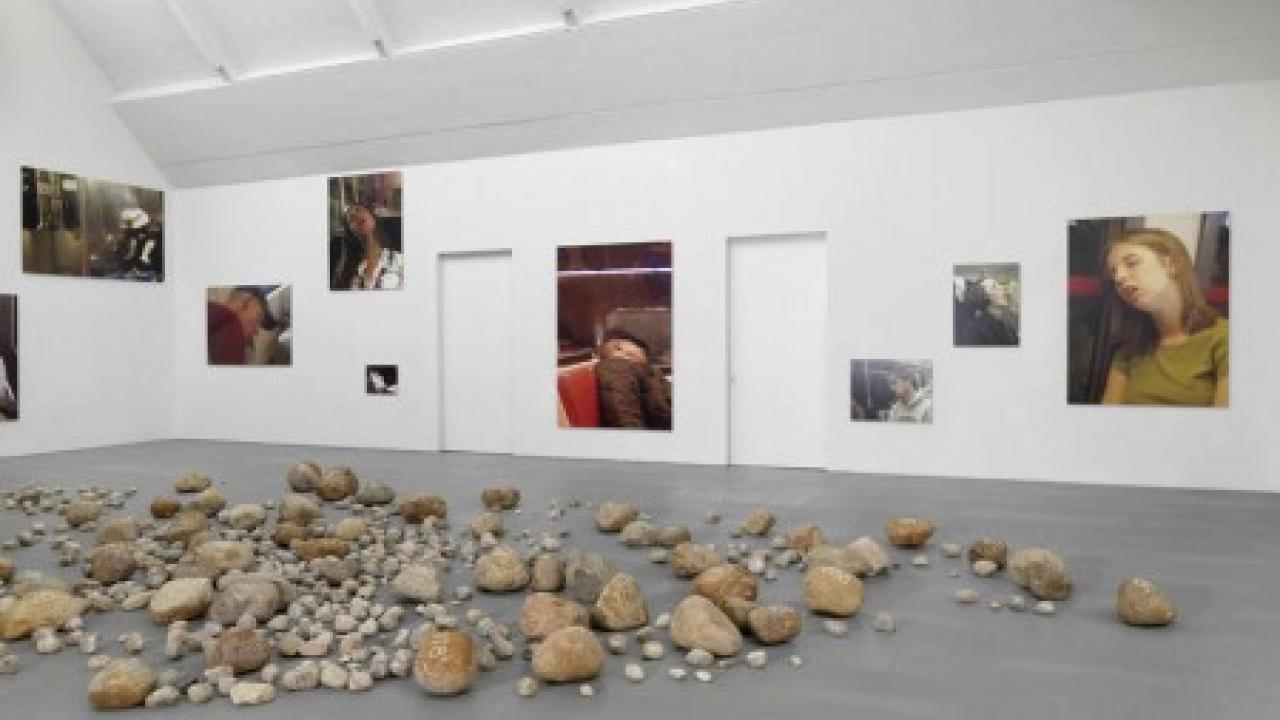
1. The sleeping commuters in Mark Wallinger’s show of strong works at Carlier Gebauer (_The Unconscious_, all works 2010). Gleaned off the Internet (i.e. usually photographed with a phone) and blown up to train-window size, these are images of people in a state of utter exhaustion and complete unawareness, which oddly makes them look ecstatically orgasmic, or peacefully dead. Both Pierre Bourdieu and George Bataille, for very different reasons though, would have loved these. Class reality and incarnated otherworldliness wrapped into one. The numbered stones of different sizes scattered across the floor equally hovered between straightforward ordinariness (just stones, just numbers) and a looming sense of encryption (is there some weird or wicked plan behind it?) (_Steine_). I also liked the video compiling unpopulated scenes of sorcery (cups and plates dancing about, drawn by invisible threads etc.) taken from Bewitched, the US 1970s comedy series about a husband and witch (_The Magic of Things_). And the entire content of The Oxford Book of English Verse 1250 –1918 printed on wallpaper and filling an entire wall, without any punctuation or titles, so that your eyes wonder about aimlessly, and you come across fragments of a poem as if they emanated from a wall of fog (_Words_). According to Mark fills the adjacent space with 100 second-hand chairs (all of different design), with the first name of the artist written on the back like on a director’s chair, while from each chair a single white thread leads vertically up to one single vanishing point on the rear wall, as if artistic authority itself was residing there like the holy spirit. Which was the right kind of irony to offset the reverence and meditativeness built up in the first room.
2. The beer-bellied, bald-headed guy in wife-beater shirt who lives in the run-down house right next to Haunch of Venison’s Berlin gallery, where on Friday night a show of works by Damien Hirst and Michael Joo opened. He seemed to take special delight in putting himself on display as the proverbially grumpy proletarian Berliner, sitting on a chair at the entrance to his building with a bottle of beer in his hand. He complained about the two Maybach limousines double-parking outside the gallery blocking the traffic, which drew my attention to how extremely ugly in fact these ultra-luxury cars are (and incidentally also ultra-slow-selling; Mercedes allegedly consider terminating the brand in the near future), bulbous and bulky. As opposed to the anorexic and/or surgically enhanced ladies of course that came with chaps that looked like the ones that Jeremy Deller had in mind when he once said that the art world is a great place to meet retired arms dealers (only that these probably weren’t retired). All of which was of course like some entertaining TV program for our beer-bellied, bald-headed guy. I’m not sure he bothered to venture inside the gallery though, where people where piling up between art piling up; the show looked a bit as if Damien Hirst and Michael Joo had conceived it separately, and then just had superimposed floor plans, so that the result looked a little crammed, like an outlet sale or food court. Marinated zebra, anyone (_Incredible Journey_, 2008)? No thanks not just now, and the inevitable question when someone would put a dead person on display to up the ante, was, funnily answered, in the separate second space nearby, not by Hirst but Joo: a life-size glass mannequin iceman-version of Martin Kippenberger (_M/S/G_, 2010), fully clothed and displayed on a freezer pedestal, with a prehistoric elk-antler hovering above. Cryogenic fugue, certainly, but of what? Not of Kippenberger, he’s well and alive in his art.
3. The brilliant, brilliant mirror piece in Olafur Eliasson’s huge show at Martin-Gropius-Bau, his first institutional show in his adopted hometown Berlin. It’s almost a crime to give it away before you’ve come across it unaware, but anyhow: it’s a huge mirror installed on a scaffolding right outside one of the grand windows of the building, creating the illusion at first that what you see is another part of the building across a small alley or yard, until you realize, of course, that it’s you and the people around you that are in the windows across that alley or yard. But the actual punch line is that you become very aware of the highly ornate façade of the building with its neo-classicist take on Italian Renaissance, as you are inside looking outside looking in. That piece alone with its gentle, unobtrusive take on the grand gesture of artistic architectural intervention is worth the show alone. And it’s interesting to see how the simple intervention of the window piece to me meant more than the huge mirror funnel installed in the atrium of the building (_Microscope_), or the foggy sauna with its light effects (_Feelings Are Facts_). I had to think a bit of Victor Vasarely, whose building in Aix-En Provence I once visited, and whose ideal was to use abstract optical effects not only as abstract optical effects, but as emanations of a utopian vision of planetary folklore (see article in frieze from 1998). This is what gives Olafur Eliasson’s show a slightly didactic, museum of natural history kind of air (the building, with its circular succession of rooms lends itself to that), but I have no fundamental problem with that. My kids loved the show dearly (their favourite piece was the dancing water hose).
4. The building in which the Elisabeth Peyton portraits were shown. 18th century Prussian baroque, smaller than the usual 19th century Berlin blocks, which once housed a high-class textile warehouse; you could still see, underneath the indoor balcony, the recesses in the wall where the bolts of fabric used to be displayed. Slightly dilapidated, and beautiful. I recognized portraits of gallerists Burkhard Riemschneider of neugerriemschneider (the gallery hosting the show in this temporary space) and Alexander Schröder of Neu (reclining, with silk scarf – late casting call for Visconti); and of Jeremy Deller.
5. The conversation over a beer I had with Nathaniel Mellors, who had given a lecture about the connection between language and physicality as part of L’école de Stéphanie, the three day talks project at Kunst-Werke (KW institute) initiated by Stéphanie Moisdon. One of his examples was this. Enjoy:
6. Talking about machine-wrapped-with-butter: Monica Bonvicini’s video No Head man (2009), based on a 2006 performance at the Sao Paulo Biennale, at Max Hetzler. Four men in suits are strolling, in that typical serious-viewer-way, through an otherwise empty White Cube; until one of them switches to fumbling around with his dick (it looks positively silly rather than pornographic), and then, even more surprisingly, suddenly hits into the plaster-wall like an ostrich into sand, with all of his extremities – while the other gentleman also partly vanish into floor and walls, to the slapstick sound of balsa wood crashing; there is a sample here.
Which gave the other central parts of the exhibition a weird and funny twist – the blinding light of the suspended nightmare of a modernist chandelier, Light Me Black (2009), as well as the grand staircase with chains leading up to the top of a free-standing wall , so that seen from the direction of the video, single heads of single visitors appear, as if in replacement for those of the ‘No Head Men’.




Secession_thumb.jpg)