



Alexandra Magnuson on Utah’s New Skiable Art Museum
Powder Art Foundation’s executive director discusses the transformation of a ski resort into an open-air sculpture park
Powder Art Foundation’s executive director discusses the transformation of a ski resort into an open-air sculpture park
Powder Mountain, a Utah ski resort, is not far from storied works of land art by Nancy Holt and Robert Smithson. Increasingly, the resort is also home to land art itself: Powder Art Foundation (PAF), a nonprofit launched by Netflix cofounder and Powder Mountain majority owner Reed Hastings, is in the process of transforming the mountain into a skiable art museum. For the 2025–26 ski season, PAF has unveiled its first phase of artworks, which range from a restaging of a historic work by Holt to new commissions by EJ Hill and Kayode Ojo; artworks by Bruce Nauman, James Turrell and Andrea Zittel will follow. Here, executive director Alexandra Magnuson speaks about the vision behind the project.
Cassie Packard How did Powder Mountain’s art park come to be?
Alexandra Magnuson: Powder Mountain’s chief creative officer, Alex Zhang, began thinking about what would become Powder Art Foundation five or six years ago, maybe even earlier. The project originated with a question: how can we incorporate art into the mountain’s landscape in a meaningful way? Powder Mountain is near major works such as Robert Smithson’s Spiral Jetty [1970] and Nancy Holt’s Sun Tunnels [1973–76]. The legacy of land art in the region brought gravity to the notion of putting art in a Utah mountainscape. When Reed Hastings acquired Powder Mountain, the concept quickly blossomed into a reality.
CP What was the larger curatorial vision behind the project?
AM Art on view to the public is almost always in a space designed for that purpose, be it a gallery or museum – even when outdoors. Sculpture parks come from the tradition of 18th century English landscape gardens, which sought to create idyllic pastoral scenes, but where every element is cultivated. Powder Art Foundation has the rare opportunity to put art into a wild natural environment and invite artists to make work for this context. This is what drives our curatorial strategy. We’re not dropping a monumental sculpture in the middle of an open field. We are creating a dialogue between the artwork and its surroundings: a dialogue that is constantly changing with the seasons. Our visitors are skiing, hiking, biking, climbing – physically exerting themselves in ways that alter perception and change their brain chemistry. This active, embodied engagement creates an entirely different experience.
CP Is it necessary to purchase a lift ticket – which is typically more expensive than a museum ticket – to experience the artworks? Is access contingent on the ability to ski and hike? It seems like there could be some barriers to entry here.
AM All the art on the mountain is installed on public terrain. Yes, there are limits to putting art on a ski mountain. Some access will be limited to lift tickets at certain times of the year; we cannot have skiers and people on foot on the same patch. But some artworks are installed near buildings and public areas and are easy to access year-round. And, during summer, visitors who can hike will be able to access all the art via hiking trails. The trails are free and open to the public and we are actively adding new trails to this spectacular terrain.
CP How did you make decisions around which artworks to feature and commission? I’m also curious about how you balanced contemporary versus historic examples of land art.
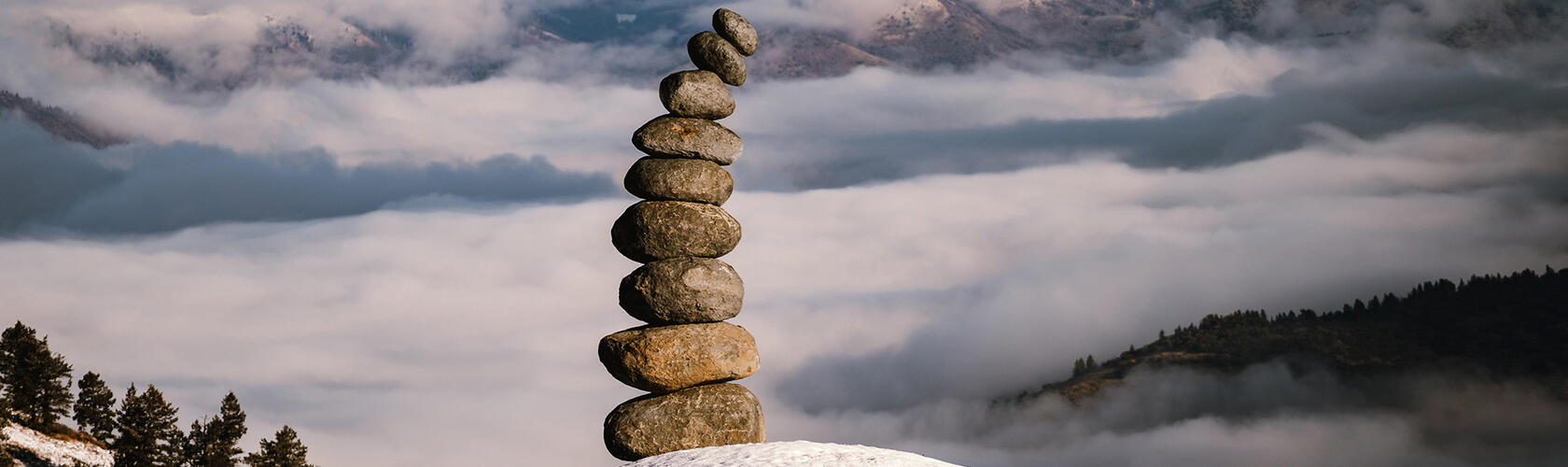
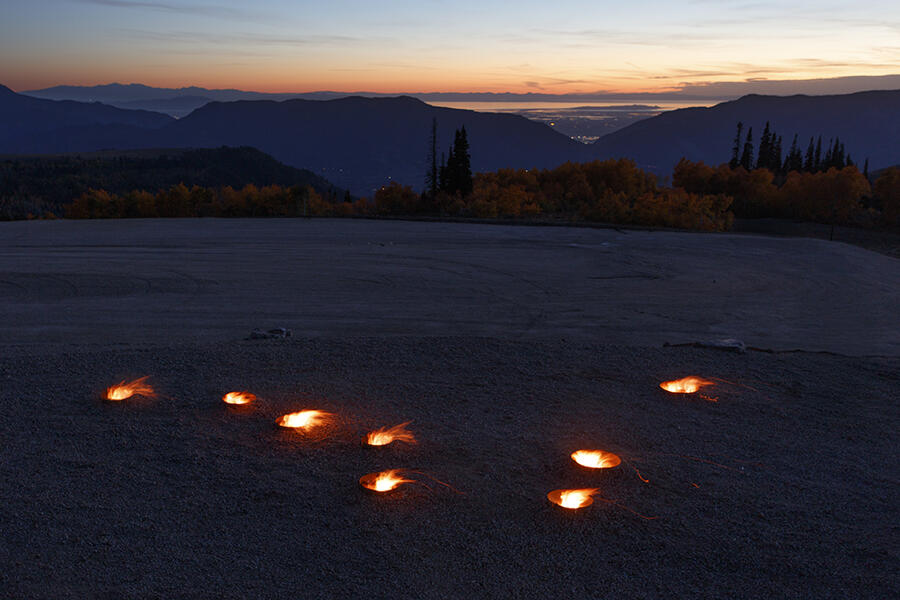
AM I think it’s exactly as you say: balance is key. There is a sense of past, present and future. A sense of human, geological and cosmic scale. We are so honored to have the opportunity to collaborate with organizations like the Holt/Smithson Foundation and to build a partnership with the Dia Art Foundation. From Powder Mountain’s summit, there’s a stunning view of the Great Basin Desert, which has been home to Nancy Holt’s Sun Tunnels for half a century. Installing Holt’s Starfire [1986] in the snow on the mountain was incredibly exciting. The work – a series of fire pits forming a constellation – has only been presented three times. It engages core concerns in Holt’s practice: the relationship between the cosmos and human experience, bringing the fire of distant stars down to a human scale. At 9,000 feet, amid vast mountain and sky, it’s spectacular. We have also realized works that never fully materialized before, like Nobuo Sekine’s Phase of Nothingness – Stone Stack [1970–2025]. This monumental stone stack was a dream the artist had for 50 years.
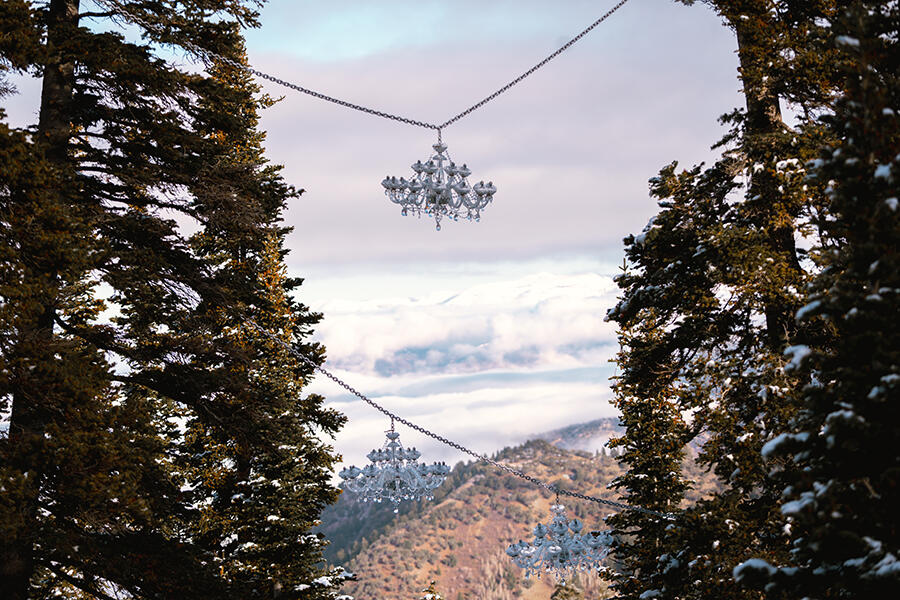
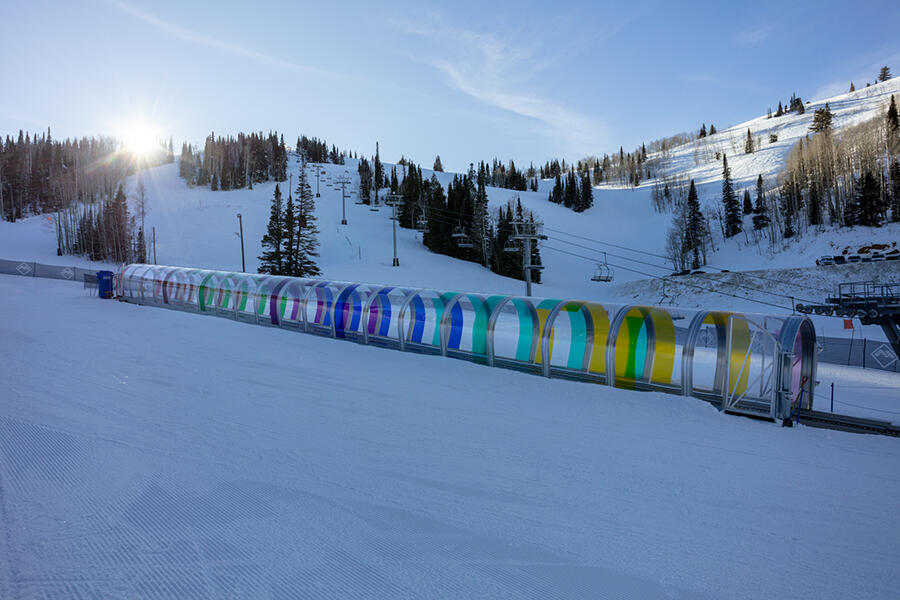
Also new this year, we have works by younger artists like Kayode Ojo and EJ Hill. Ojo works with found objects and often composes sculpture in response to gallery architecture. We provided a completely different context for his unique material vocabulary – in this case, chandeliers in trees […and that they hadn’t heard us calling, still do not hear us, up here in the tree house…, 2025]. As chandeliers evolved, they increasingly incorporated references to the natural world, so in a way the work returns these abstracted tree forms to the forest.
CP What are you working on now? I hear that there will be a pavilion with pieces by James Turrell and Bruce Nauman.
AM Yes, Powder Art Foundation has a number of stellar projects in development – including one by Andrea Zittel that’s inspired by her mobile living units and structures in A-Z West [2000]. Andrea’s focus on long-term care and engagement with place dovetails with the foundation’s principles. It has been interesting to work together to think about stewardship and advocacy as they relate to placemaking. Our project provides a great opportunity to recontextualize art outside galleries and art-designated spaces. There is so much possibility in putting art into the wilderness.
Main image: Nobuo Sekine, Phase of Nothingness - Stone Stack, 1970/2025, natural stone, steel, 579 × 94 × 142 cm. Courtesy: © Nobuo Sekine Estate, courtesy Powder Art Foundation; photograph: Carlson Art Photography