



Nicole Yi-Hsin Lai on Inviting Community to the Taichung Art Museum
On the occasion of the institution’s grand opening, the director discusses her goals for the future and how she plans to connect with the local art scene
On the occasion of the institution’s grand opening, the director discusses her goals for the future and how she plans to connect with the local art scene
Marko Gluhaich When did you first get involved with the Taichung Art Museum?
Nicole Yi-Hsin Lai I began working for the city Cultural Bureau in late December 2023, as the museum entity was in the final stages of being established. After the museum was officially launched in March 2024, I was then able to assemble my team.
MG How has the role developed since you started?
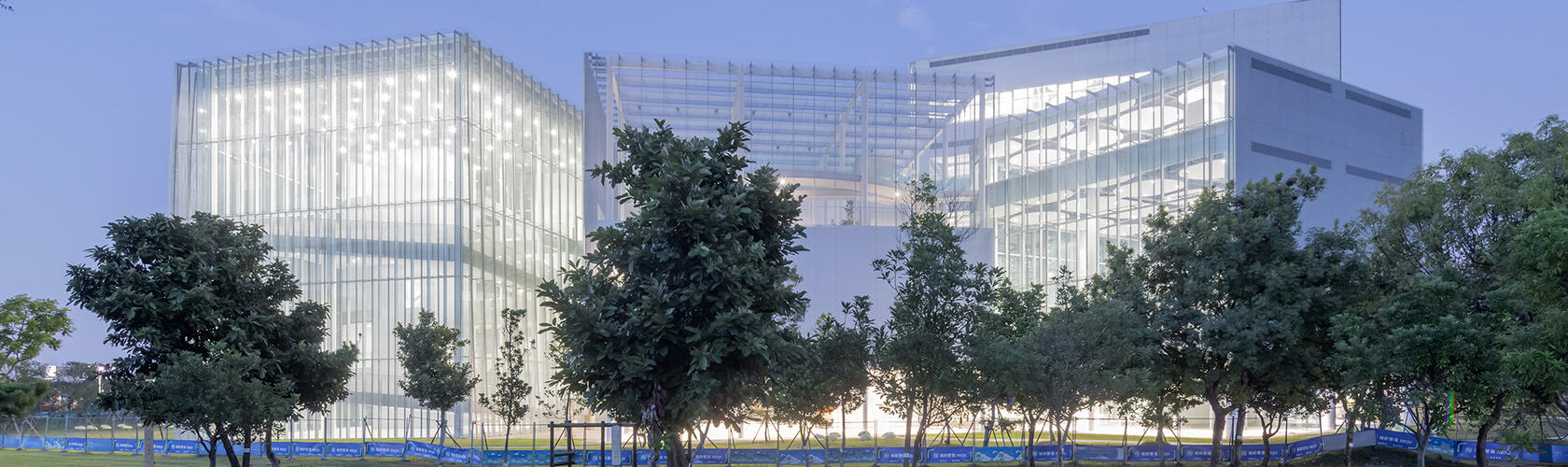
NYL In the beginning, I focused on understanding how the idea for the museum emerged and how its mission aligns with that of the adjoining library. I also learned about [the architecture firm] SANAA’s vision and how the building was designed to create a fluid relationship between the park, the museum and the library.
From this foundation, my colleagues and I began to think about the museum’s identity: how it should relate to the city, the park and the public. We considered how we could invite the citizens of Taichung to the museum. We developed a yearlong series of public programmes: talks on architecture and ecology, and workshops with schools. We also hosted events in the park to show how the museum would be woven into the community.
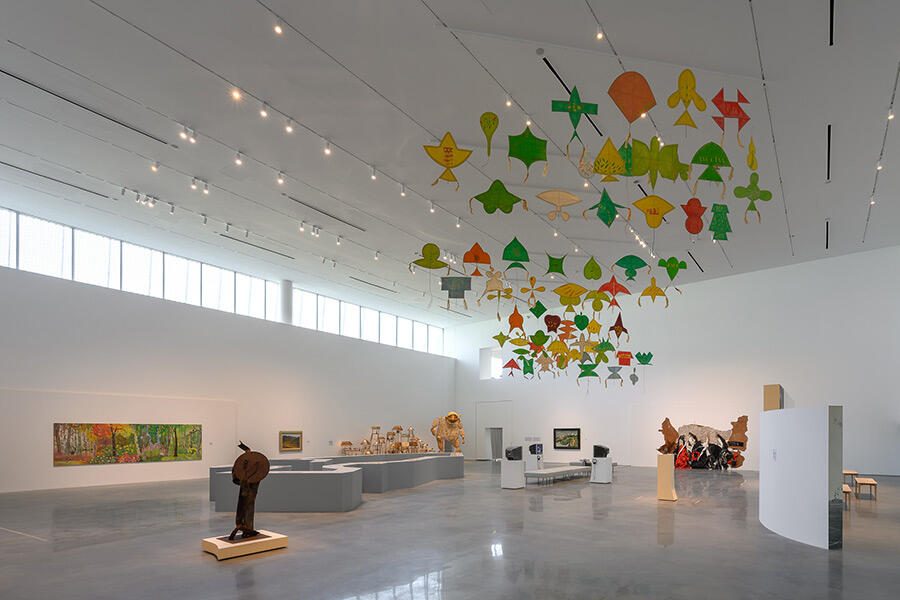
At the same time, we were preparing the grand opening exhibition and exploring what kind of educational programmes could take place inside the museum. A major question for us was how different audiences would use the museum and how their visits would become meaningful and memorable. We considered how people would move through the spaces, how they would receive information from both the exhibitions and the discrete artworks.
Because we are a city-established institution, research into local Taichung art has been important for us. Before I joined, the Cultural Bureau had already organized exhibitions on Taichung art history. Since I arrived, we have continued this line of research and have focused on establishing our arts archive.
MG How does your vision for Taichung Art Museum build on your previous curatorial interests – especially your work on urban environments and their link to artmaking?
NYL My curatorial interests have long centred on the relationship between the arts, the city and people’s lives. At the Taichung Art Museum, it’s become not only about the relationship between the museum and the city but also about the museum and the large urban park in which it’s situated. SANAA’s architecture dissolves the boundary between inside and outside. It encourages us to think about how humans, their environment and artistic experience all come together.
Because we are a young museum, we’re thinking about how to bring this dynamic mode of curatorial practice or art education into our practice at the museum. For example, for the grand opening exhibition, we invited three mid-career female curators – Alaina Claire Feldman, Anca Mihuleţ-Kim and Ling-Chih Chow – each from different cultural backgrounds and with distinct yet related ideas of environment. It’s not a single curator’s view that represents the whole exhibition.
We’re also trying something new for art education. For instance, we’ve made our storage unit visible so that audiences can gain an understanding about how artworks are restored and preserved. We are transforming professional knowledge into something that can be engaged with and learned about.
Cross-disciplinary artistic forms are also important for us. We are currently planning an architecture exhibition but also have ideas around body-centred performance and sound projects. We have a core value: not setting boundaries on what we can or cannot do.
MG What other educational initiatives are you working on?
NYL We are introducing Play Space Plug-In, an initiative that distributes playing spaces throughout the museum, in the galleries and the library, breaking the model that there needs to be a single, separate location where children and adults go to interact with art.
MG What can you tell me about the opening exhibition and the considerations that went into it?
NYL The opening exhibition looks at the relationship between humans and the environment. Its contents are not just artworks but also nature. Because the blurred boundary between inside and outside is already present in the museum.
This is just the starting point. Looking at the history of art in Taichung, there are numerous instances of works using the environment – from scenic landscape paintings to bamboo weaving and clay works.
Anca is focusing on how humans perceive nature and how reproduction can be applied to spiritual or theoretical practices. Alaina, meanwhile, is focusing on the relationship between human and non-human beings and engaging animals and plants more directly. Ling-Chih is bringing in performance and body works, including artists who use their bodies to express their relationship with different environments.
Meanwhile, the museum team is focusing on master painters from Taichung and the museum-commissioned contemporary works by Michael Lin and Haegue Yang, which begins a biennial commissioning programme.
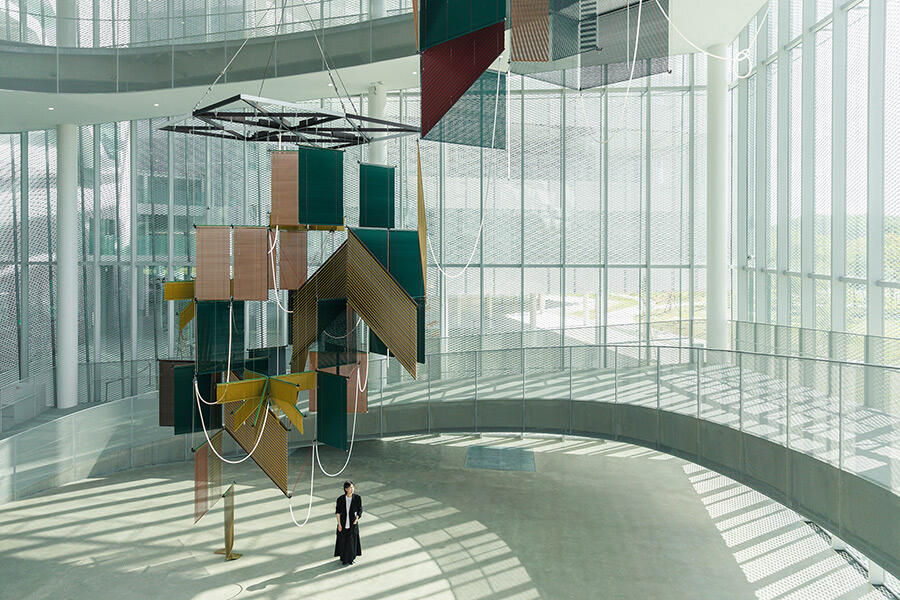
Yang’s commission responds to the architecture, incorporating master trees from Chinese and Korean worship and using Venetian blinds to construct the work, which will be lit up and therefore visible from the park at all hours.
Lin will superimpose a Taiwanese floral pattern above the lobby desk that people will only be able to access if they use the pathway between the museum and the library. It will affect how people feel about the lobby space and the architecture of the building more generally.
MG How does the art museum relate to the library, and how has that shaped your work?
NYL We coexist, collaborate and co-work with the library. We are two individual institutions based in one bigger place, so this is our basic condition. We run the place together and then there are so many pathways connecting the museum and the library, so if you are coming to visit the museum, you might accidentally walk into another space that’s in the library.
The library has become an inspiration for the museum. Many of the exhibitions we are planning will incorporate reading areas and display artists’ books. We’re also creating a residency programme across the two institutions that’s open not only to visual artists but also writers and cross-disciplinary artistic workers, thinking about these relationships conceptually.
The library director, Tseng Hui-chun, once described to me how the museum and the library operate a bit like the right and left sides of our brain. It’s about sense and sensibility, always functioning together. This is the impression that we want our visitors to leave with.
It’s great for the public. We are the first dual institution of this kind in Taiwan. Operationally it may be difficult, but conceptually it’s a very attractive model.
MG How have you visualized the museum’s future, and how does that vision guide your initiatives?
NYL We want to focus on the development of Taichung art history, produce more research and diversified viewpoints through exhibitions and establish relationships with the international art scene by collaborating with different institutions and curators.
In general, though, we want to become a social and cultural centre for both citizens and visitors of Taiwan. Because art museums are relatively new here, people haven’t necessarily integrated them into their daily lives and can feel disconnected from them, unlike libraries, which we visit from a very young age and always know how to use.
Because of our integration with both the library and the park, we are more connected with people’s daily lives and can be more inviting to the public. If we can establish strong communication with the public and engage them in our arts education programmes, we can begin the long journey of bringing more visitors to the museum.
Main image: Exterior of Taichung Green Museumbrary, designed by SANAA Architects. Courtesy: Taichung Art Museum; photograph: Iwan Baan