


Jana Euler’s Paintings Explore the Perversity of the Present
At Greene Naftali, New York, the artist’s canvases underscore the difference between prompting and painting
At Greene Naftali, New York, the artist’s canvases underscore the difference between prompting and painting
New ages come with new images to gild them. Whether in protest or adulation, images that take information and power as their subject must also contend with other forces in play: an era’s universalist ‘truthiness’, which, when created by those in power, curdles into moralizing allegory; and the material conditions of the ‘now’, which anchor the work to its time. Pablo Picasso’s Guernica (1937), with its cubist dismemberment, fit the ravages of the Spanish Civil War. Every era leaves a world that couldn’t have been made in another time. What remains are forms calibrated to its technologies and terrors, registering how ideology has travelled through it.

What paintings, then, could stand as totems for the perversities of today: the way screens contort the body as we plummet down online rabbit holes? What reflects the uncanniness of staring into the fun-house outputs of technologies averaging out human creativity into a collective hallucination? What image would feel at home in the court of today’s techno-utopian monarchists? The answer is probably More Morecorns (2025), Jana Euler’s painting of two unicorns with multiple horns – ‘morecorns’ – procreating on Route 66. A metallic storm gathers as a pink morecorn mounts its baby blue mate. ‘More, more, morecorns’, you can imagine a real-life Logan Roy from Succession (2018–23) barking to the tune of ‘boar on the floor’.
Euler’s paintings in ‘The center does not fold’ are the Guernicas we deserve. They take on dark fantasies of the technological sublime: smoothness made vulgar, buckling on impact with the embodied reality of being an artist today – stuck in a fleshy quagmire, grasping at how the creative act even happens. The paintings orbit creativity itself: canvases titled Creative Act (Spray can) and Creative Act (Paint tube) (both 2025) show the media – humble cans and tubes – after hours, feeling randy, begetting more of themselves in the biblical sense. Others circle AI. One shows pink and yellow horses making out, against a black void, surrounded by brown parcels: The fantasy of a highly potent creative act with little participation of human mankind, and the sheer multitude of packages that fly back in return (2025). The ‘packages’ here represent the ubiquity of online purchases (and deliveries) and training data behind generative AI, so casually mistaken for the creative act.
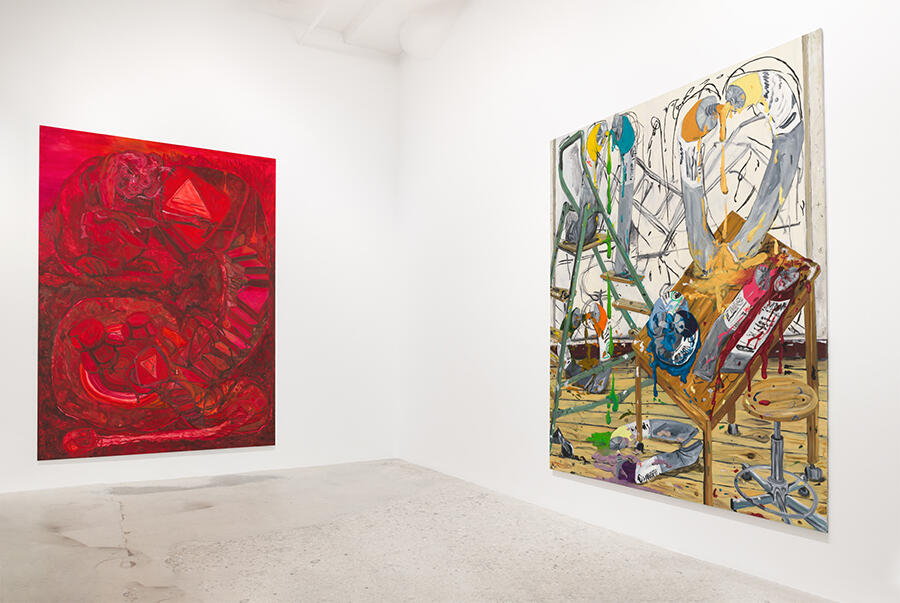
Dog Walking (2025) – a giant dog with Mary Tyler Moore hair and tiny legs – functions as Euler’s caricature of the grotesque distortions endemic to prompt-generated imagery. The uncanny lies in the comedic horror of the technological eye mistranslating our world. Much of the show reiterates this blunt point in paint: creation is an exertion of human will. It involves a body mastering itself and the material at hand. The maxim of the exhibition could be: there is a difference between prompting and painting. And isn’t it obscenely hilarious to be a body – an artist in a studio – confronting electricity-guzzling technologies and responding with a stubbornly oblique, human interpretation of it all? Is that enough? Does it have to be? As an artist lumbering down a city street, it feels only natural to imagine oneself as a six-story-tall owl on a mission (On the way to the studio, 2025).

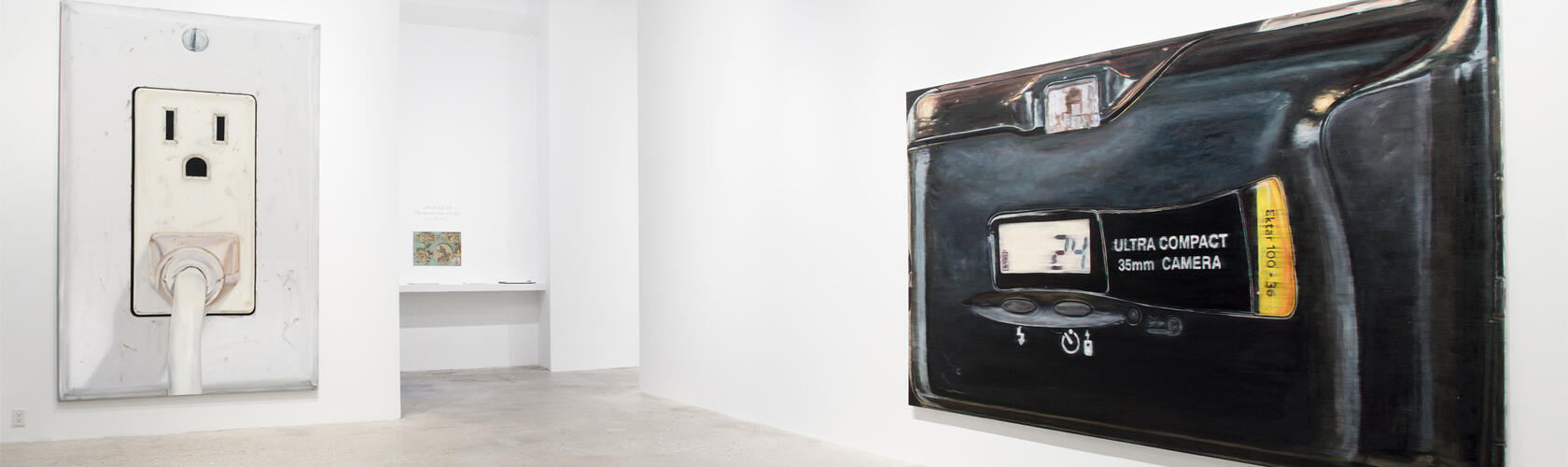
And what is the cost of all of this? Euler spells it out. Where the energy comes from, connected (2025) is a close-up of an American electrical outlet. Nearby, five canvases depict dollar bills in various styles and degrees of abstraction. The bills look quaint, but their presence reminds us that the conditions of making are never isolated from capital. With cold hard cash on canvas, Euler shruggingly reminds us that it does, in fact, be like that sometimes. As the saying goes: twenty dollars is twenty dollars.
Jana Euler’s ‘The center does not fold’ is on view at Greene Naftali, New York until 10 January
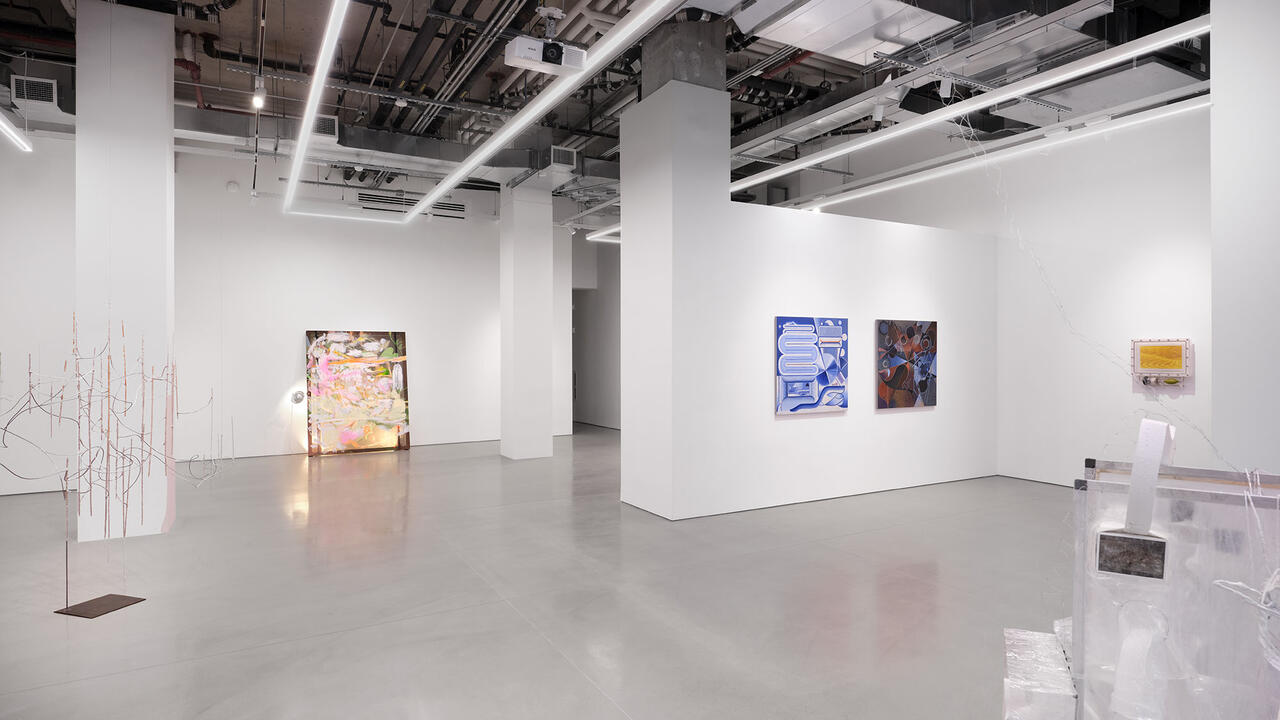
Main image: Jana Euler, ‘The center does not fold’, 2025–6, exhibition view. Courtesy: Courtesy: the artist and Greene Naftali, New York; photograph: Júlia Standovár