



Magali Reus’s Fishing-Lure Sculptures Set a Subtle Trap
In her latest series, the artist flirts with silhouettes and revels in cunning – the art of luring, hooking and capturing the viewer
In her latest series, the artist flirts with silhouettes and revels in cunning – the art of luring, hooking and capturing the viewer
This piece appears in the columns section of frieze 256, ‘The Shape of Shape’
Late last year, I spent a few weeks in my birthplace of The Hague, the Netherlands, preparing for my exhibition at Museum Beelden aan Zee. In the early mornings I would go for runs in and around the local parklands, where I encountered enigmatic figures cloaked in dark green and brown attire, dotted amid the lake mist. Like silhouettes, almost invisible, they variously appeared and disappeared, merging with the shrubs and grasses along the lake. Fishing in those waters is not allowed, so their activities seemed to demand that type of clandestineness. Beelden aan Zee is nestled in a dune landscape overlooking the North Sea, right beside the harbour, which is home to local fisheries and seafood restaurants.
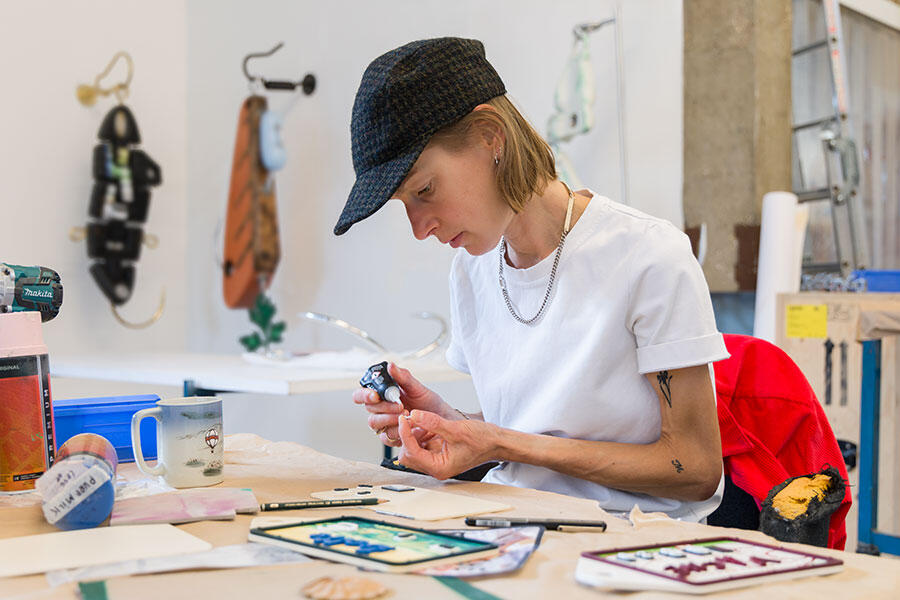
The museum is a modernist building designed by Wim Quist; its incredibly tall ceilings and full-length windows conjure the sense of an aquarium, with the visitor feeling dwarfed, like a fish in a bowl. The walls are constructed from poured concrete blocks, each with a bolt- ready, centralized threaded insert, which provides the only means of attachment for wall-based works.
I wanted to produce works that considered all these aspects: the idea of silhouettes or outlines; the local production and consumption of fish; the idea of the fish-bowl museum that ‘catches’ and displays the visitor; and, finally, the practicality of fixing works to a wall that necessitated hanging forms.
Water, like a lens, can distort. A little piece of reflective foil can suggest the sheen of scales on fish skin; a stack of toothpaste caps can mimic the layered body of a jellyfish; a metal spoon on a hooked line, when dropped into a ripple of water, can spin around like a silvery body in motion. All this visual trickery can be used to fool a hungry sea creature into believing it has been presented with a meal.
I started to think about the activity of fishing and what takes place when something is dropped down into darkness as a mode of communication and in dialogue with a body of water, and what it means to shape forms that are designed for trapping or catching attention. What is required to seduce the projected other that one is trying to catch? It necessitates attempting to access their instincts, which demands a momentary shift of projection: to become the prey.
This led me to create shapes that would each be highly individualistic, both in outline and materiality. These shapes would speak of different characteristics, conveying distant glimpses of both animal and animated things. The individual works within the ‘Rig’ series (2025) draw their visual cues from a unique set of social, cultural and historical – but also fictional and personal – references, each engaging the viewer in a distinct tone or manner with the aim of speaking to different parts of the brain, whether through resonance or appeal.
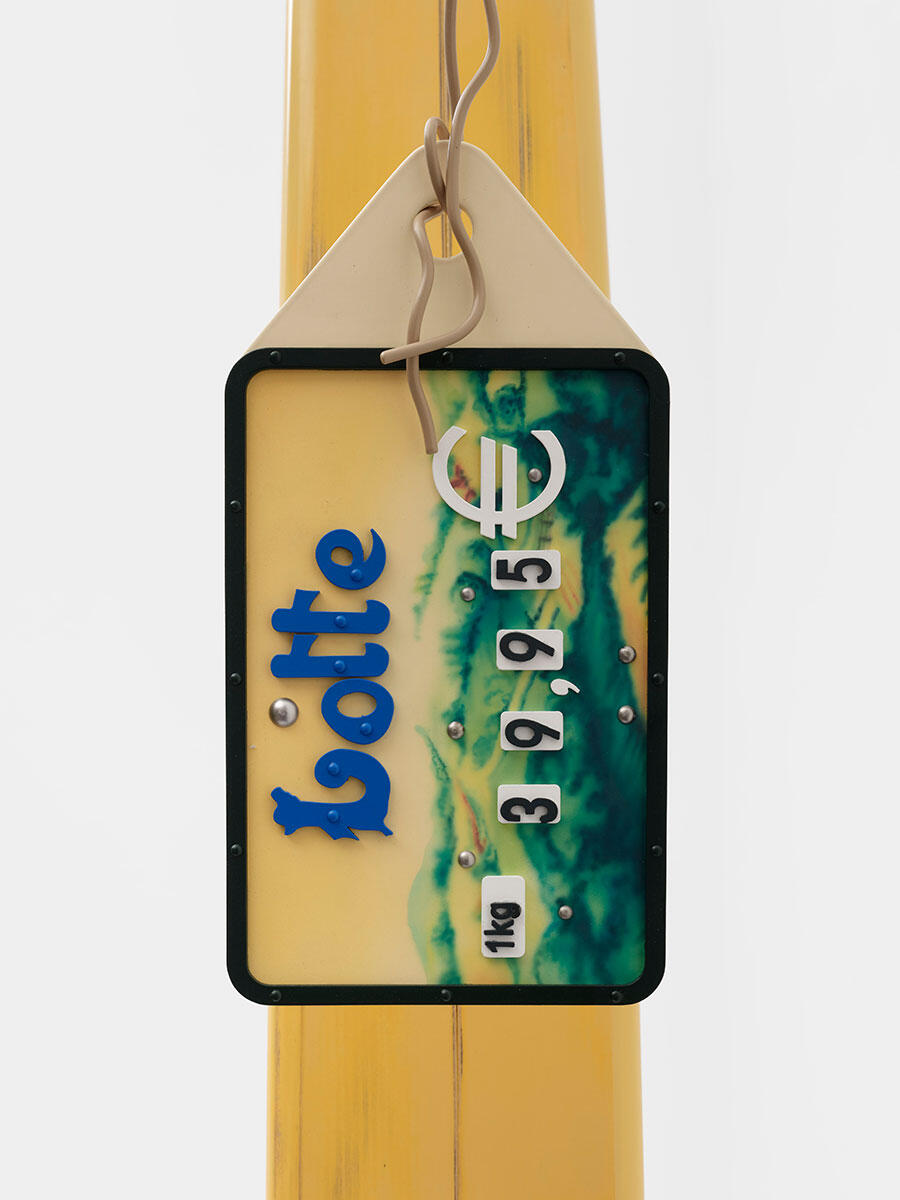
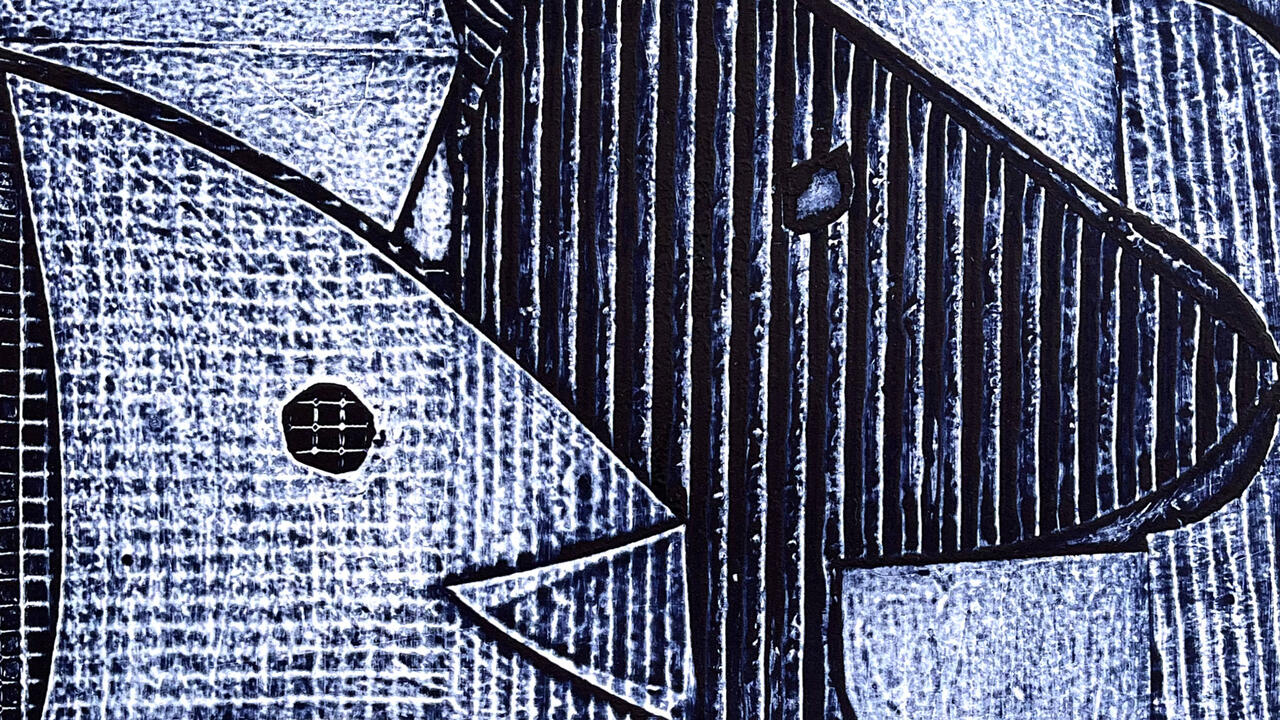
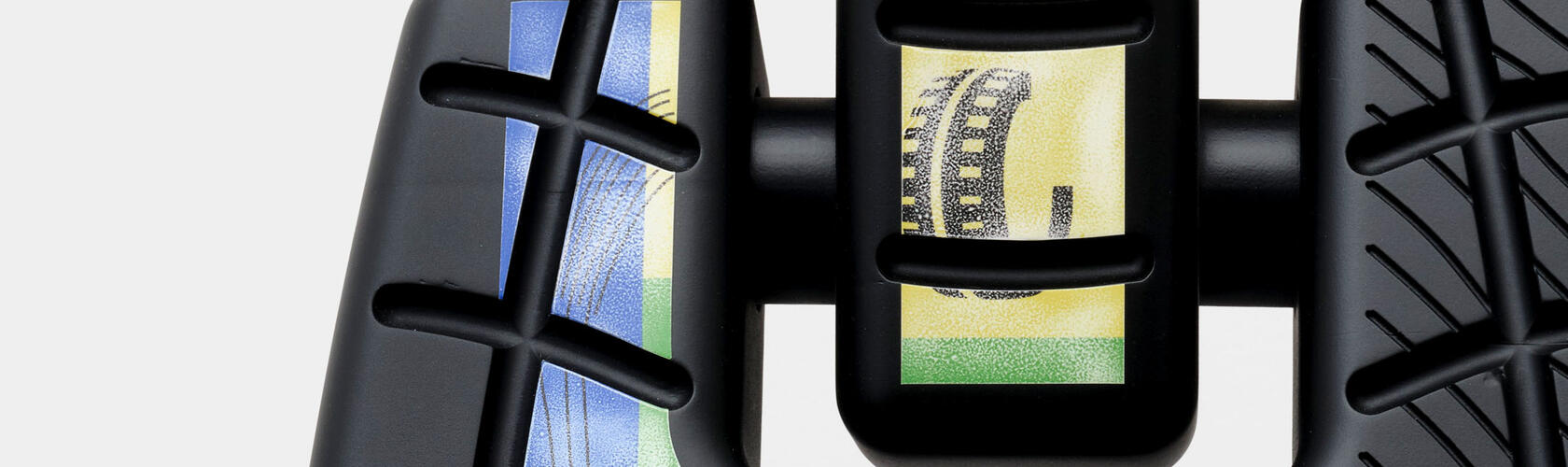
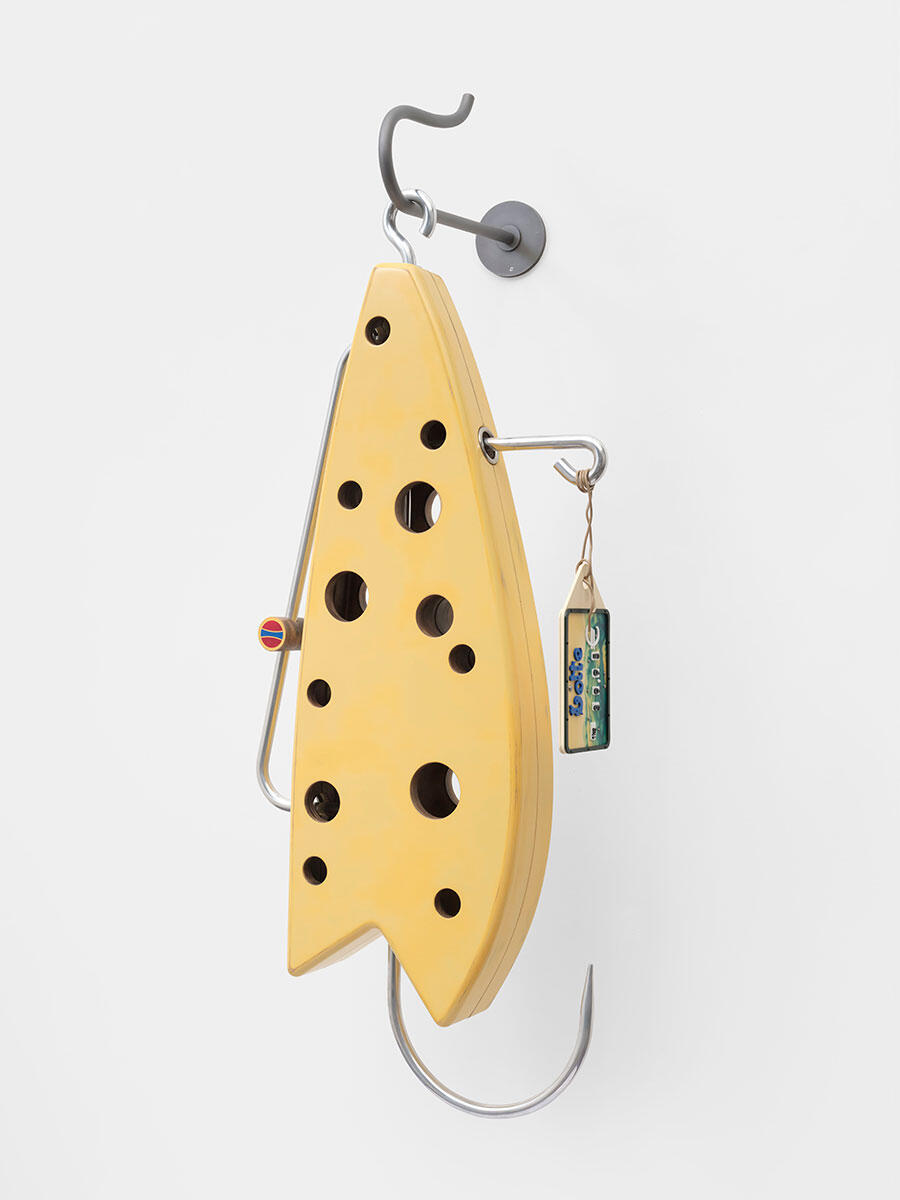
Rig (Miles, 43) and its outline, for example, could be easily reminiscent of a fish shape; however, its matt black colour and rubbery, grooved texture and graphics promise something more in the spirit of car tyres and shoe soles: the potentiality of travel or a journey into another, more land-bound direction. And the fishy silhouette of Rig (L.Pasteur) is rendered in a somewhat childlike manner, while its overall perforated, yellow, waxy skin immediately calls to mind the surface of Swiss cheese, especially for those with lunch on their minds.
Fishing lures can be store-bought, but there are also the subcultural, hobbyist versions that take the form of playful, innovative, makeshift objects. All hinge on the idea of a sly craftiness: the desire to hook and to catch, leaning on the imagined capacities of the projected, hunted other.
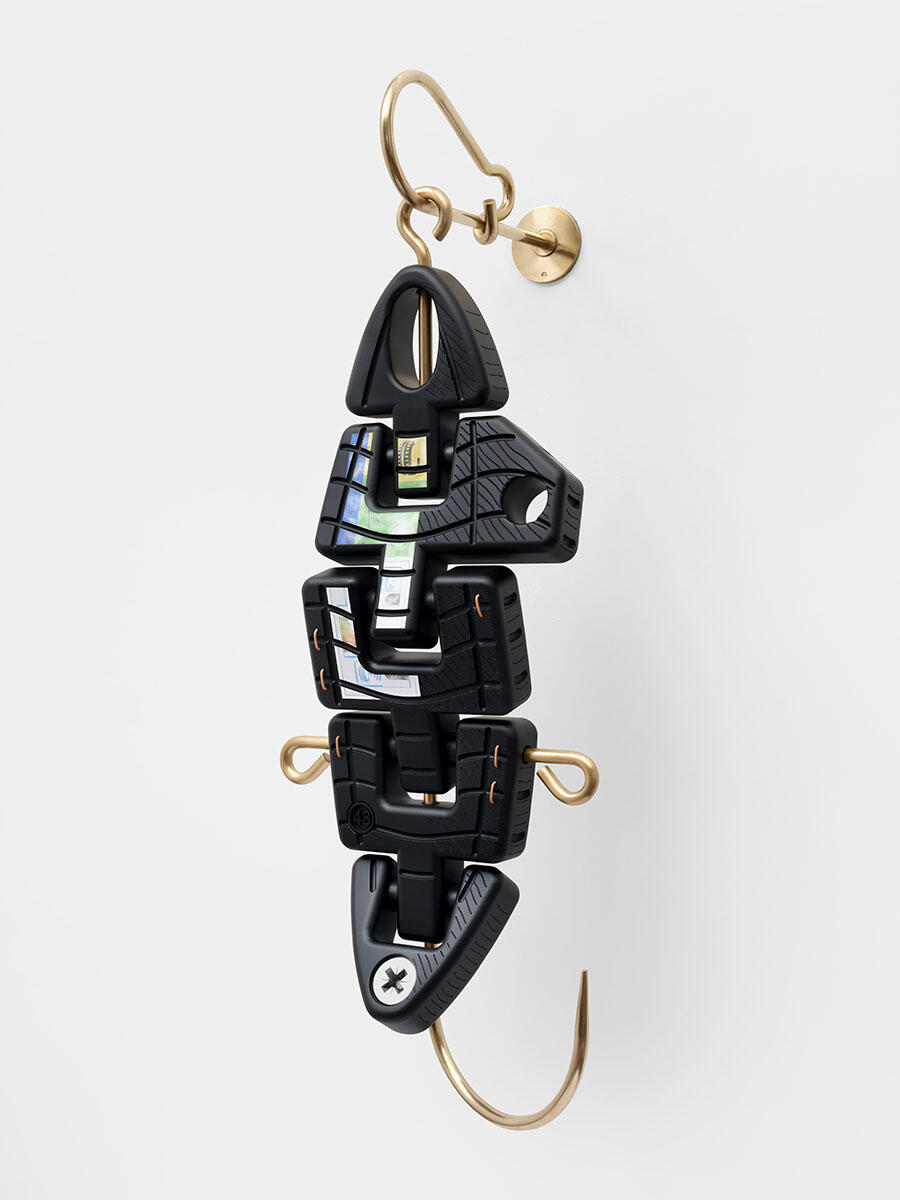
I tried to challenge myself. Could I animate certain ‘non-fish-like’ objects into something animal? I was interested in exploring those objects and trying to force them into conjuring up a fish. I wanted to set limitations for myself – respect- fully leaving the object be, while creating a sense of a slipperiness and transformation. The un-fish-like objects briefly become fleetingly animal characters cloaked in costume, whether through their silhouette shapes, their skin decorations or surface textures.
Silhouettes hold a flirtatious potential; they are shadowy shapes, ones not defined and filled in to form a palpable body. This not yet allows them the potential of external projection but equally keeps them infinitely intangible and impossible to capture, granting them a certain deviancy and autonomy – two qualities I am interested in when making sculpture.
As told to Marko Gluhaich
This article first appeared in frieze issue 256 with the headline ‘Catch and Release’
Magali Reus’s ‘TALES AND REALS’ is on view at Museum Beelden aan Zee, The Hague, until 3 May
Main image: Magali Reus, Rig (Miles, 43) (detail), 2025, matt-lacquered, painted polyester, sanded transfer, forged, brushed, brass-plated, oiled steel bar, forged, brushed, brass-plated, oiled aluminium bar, mirror-polished, sand-cast aluminium, painted aluminium wire, 57 × 51 × 149 cm. Courtesy: Magali Reus, The Approach, London, Galerie Greta Meet, Brussels, MAI36, Zurich, Tanya Bonakdar Gallery, New York; photograph: Eva Herzog