



Małgorzata Mirga-Tas Patches the Gaps of History
At Kunsthaus Bregenz, the artist’s textiles and sculptures weave family, myth and craft to celebrate Roma culture
At Kunsthaus Bregenz, the artist’s textiles and sculptures weave family, myth and craft to celebrate Roma culture
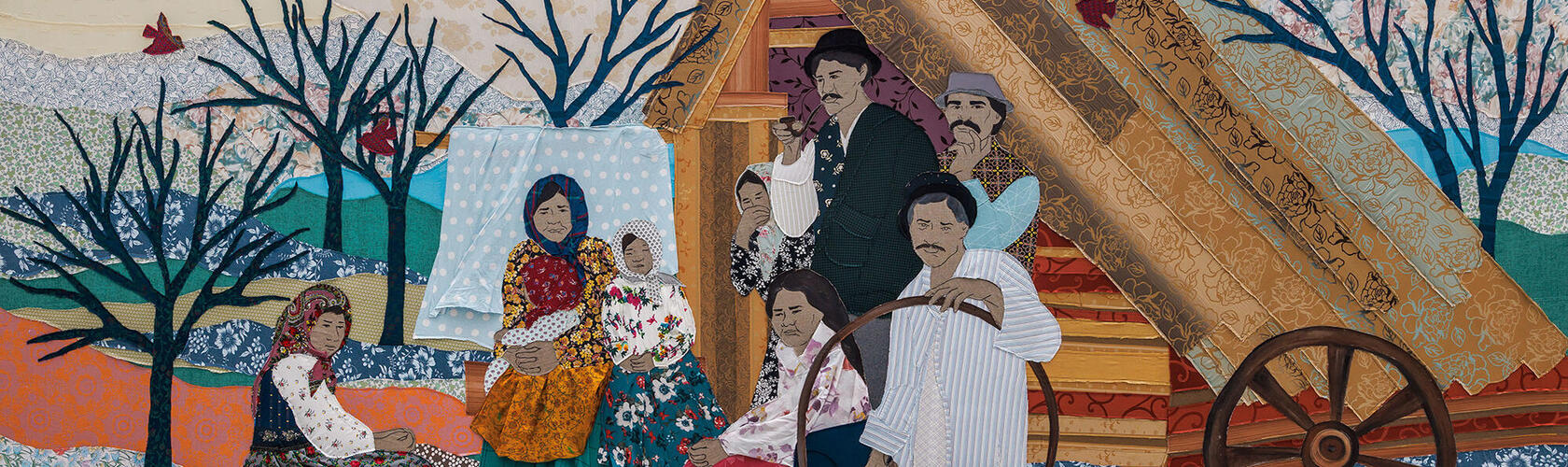
Małgorzata Mirga-Tas’s hometown of Czarna Góra, a Romani village in southern Poland, is not a place most visitors to Kunsthaus Bregenz will have heard of. Yet over three floors of Peter Zumthor’s famously austere building, her exhibition ‘Tełe Ćerhenia Jekh Jag’ (Under the Starry Heavens a Fire Burns) invites us into its reimagined version – one tightly constructed by the artist not as an ethnographic record but as a shifting constellation of tradition, memory, dream and utopia.
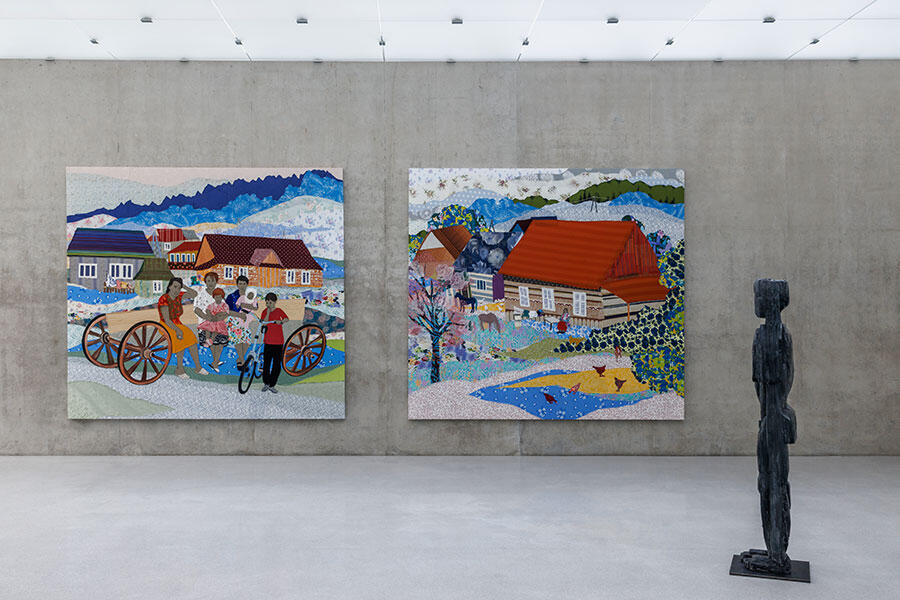
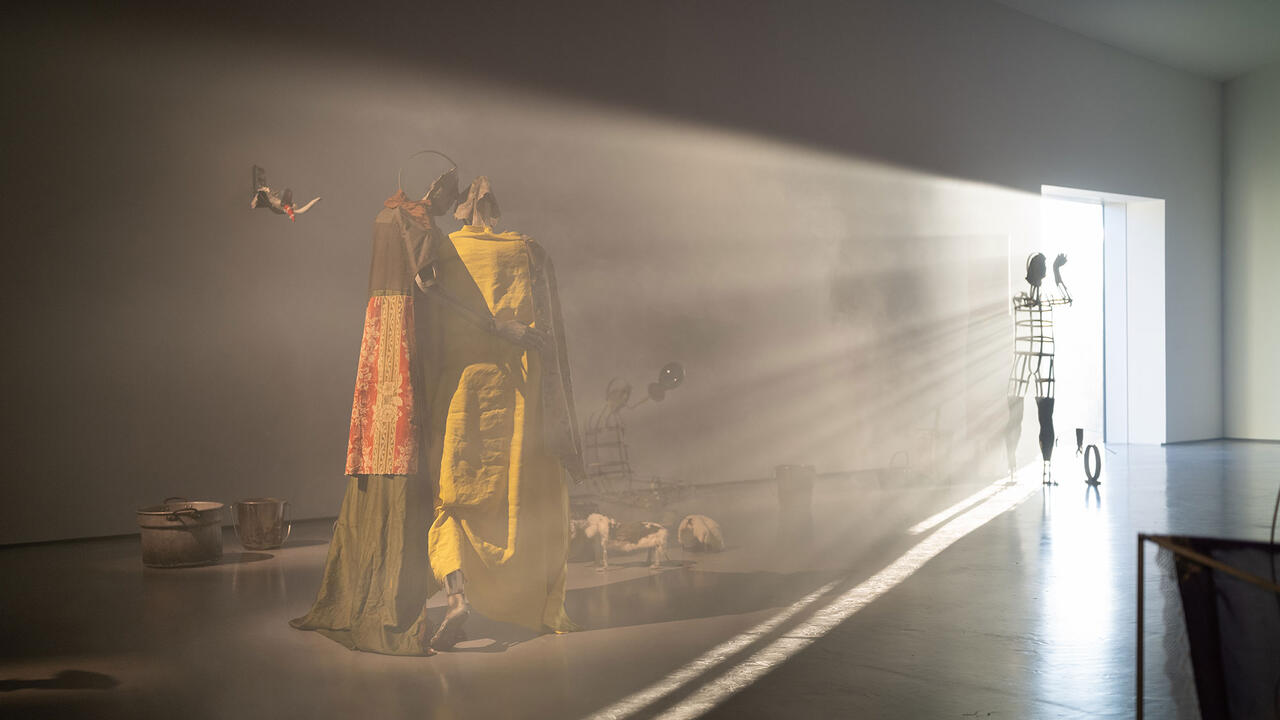
Mirroring the museum’s architecture, Mirga-Tas’s storytelling unfolds in three ascending layers; a murmured sound piece by her uncle, Roma poet Jan Mirga, guides the climb up each staircase, introducing the exhibition’s focus on Roma culture. Upon entering the first floor, Mirga-Tas evokes her home village with her signature elaborate textile collages. These densely layered works, such as Miro than, miro smirom (My place, my peace of mind, 2025), are monumental in size yet playful in their colourful rendition of little clusters of houses, of family and neighbours posed in front of their homes, their horses grazing nearby. Dotted between them are the ‘Jangare’: large, blue-black male figures moulded from paraffin wax mixed with soot. Described in the exhibition text as ‘faceless, silent companions’, they appear both vulnerable – with arms closed across their chests – and as protective guardians. Meanwhile, the textile work Jangare’s Magic is in Our Hands (2025) focuses on the agency of the myth makers, depicting a group of women stitching away on a figure made from the starry sky, delicate gold yarn protruding from the surface.
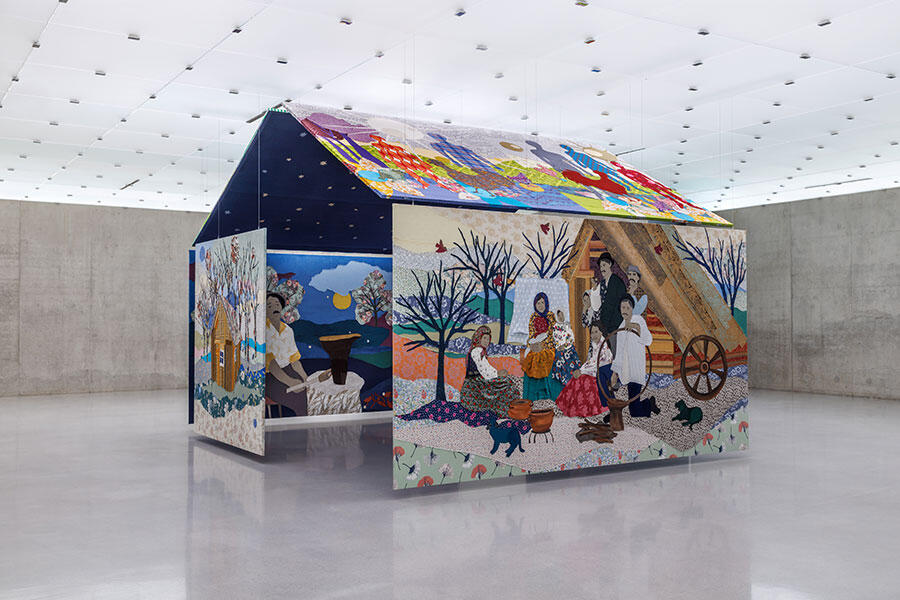
On the second floor, the world of the exhibition narrows to a single site: the forge, a laboratory of craft, art and poetry in the Roma tradition, since blacksmiths are often singers and chroniclers. Mirga-Tas reconstructs the memory of her great-uncle Augustyn’s workshop as a house-like structure assembled from six vast textile panels. Its outer surfaces pulse with elaborate patterns and dense embroidery featuring the community at work or in the midst of travel, as in Pałe Buci (After Work, 2022); inside, however, are quiet landscapes made from plainer fabrics in muted colours. Here we encounter Grandfather Jan and his brother Kovacic Gusteko (Blacksmith Augustyn, both 2025), as well as remnants of earlier works and fabrics, producing what the catalogue calls Mirga-Tas’s ‘palace of memory’ – interlinking her own role as an artist with that of the blacksmith as one who both transforms matter and conserves history.
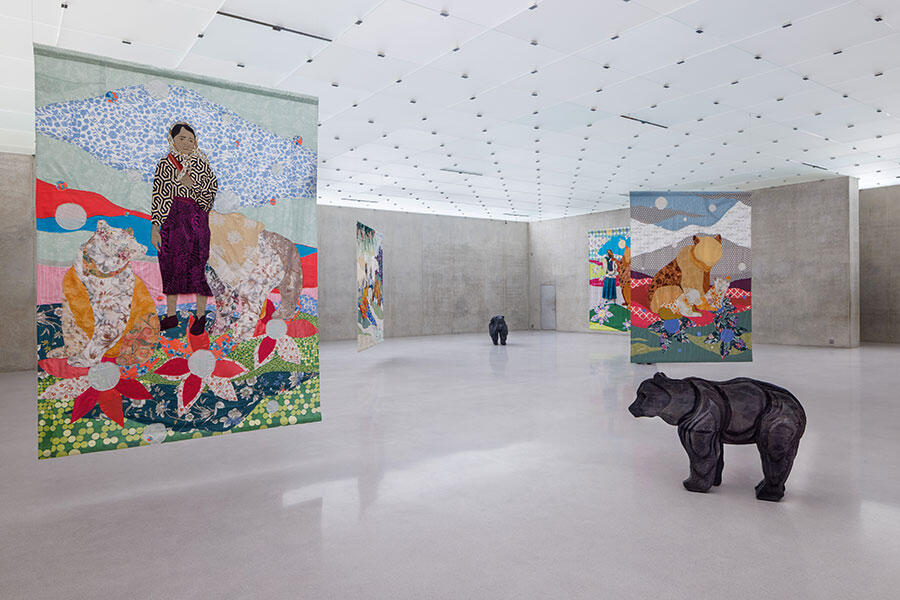
The third floor leaves the settlement for the mountains, entering the ‘habitat of the bear’, according to the wall text. Like blacksmithing, bear training is a long-standing Roma tradition, but Mirga-Tas inverts the painful historical motif of the chained, dancing animal into a utopian vision. Several monolithic bear sculptures roam the space (Ryćhino [Roma Bear, 2025]), while accompanying textiles show humans and bears mingling in scenes of leisurely coexistence, such as Ando ada dziwes judut deł amengie zor (Light from the day gives us a lot of strength, 2025). If the first floor speaks of daily life and the second of ancestral memory, this is the realm of possibility – an imagined future where difference does not imply danger and distance.
As a Romani artist concerned with the minority’s representation, Mirga-Tas shifts her community’s image away from the objectifying gaze of documentary and towards a decidedly authored, subjective sphere. Her deftly handmade textiles, with visible seams and protruding frills, reject the smooth fiction of pictorial space, insisting instead on process, labour and touch. The women she depicts stand as makers of the work itself and of the world it reveals. ‘Tełe Ćerhenia Jekh Jag’ asks what it means to carry a home within you and to imagine its future under the shared canopy of stars, gathered around a common fire.
Małgorzata Mirga-Tas’s ‘Tełe Ćerhenia Jekh Jag’ is on view at Kunsthaus Bregenz until 28 September
Main image: Małgorzata Mirga-Tas, Kovaciskri Romani familia (Roma blacksmith’s family), 2025, textile, mixed media. Courtesy: © Małgorzata Mirga-Tas; Kunsthaus Bregenz; Foksal Gallery Foundation, Warschau; Frith Street Gallery, London; Karma International, Zürich; photograph: Markus Tretter