



Luciano Castelli Keeps the Self in Motion
At Kulturstiftung Basel H. Geiger, the artist brings together five decades of work exploring gender mutability and a sustained fascination with Asian cultural forms
At Kulturstiftung Basel H. Geiger, the artist brings together five decades of work exploring gender mutability and a sustained fascination with Asian cultural forms
Over a career spanning more than five decades, Luciano Castelli has continuously reinvented himself across painting, photography, sculpture, music and performance. Now 74, his exhibition ‘Whispers of Japan’, at Kulturstiftung Basel H. Geiger in Basel, brings together a slew of works that testify to his persistent gender mutability as well as an ongoing fascination with the Asian region.
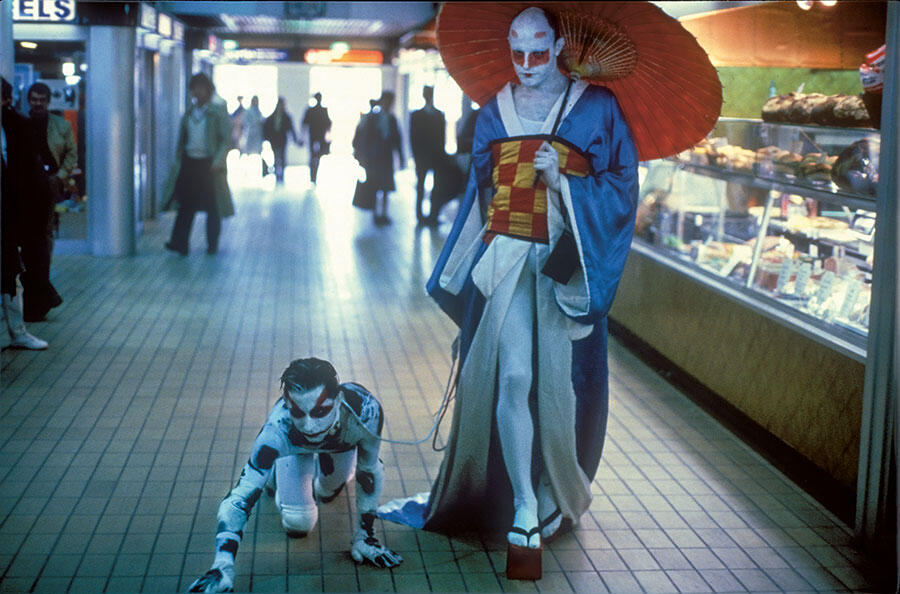
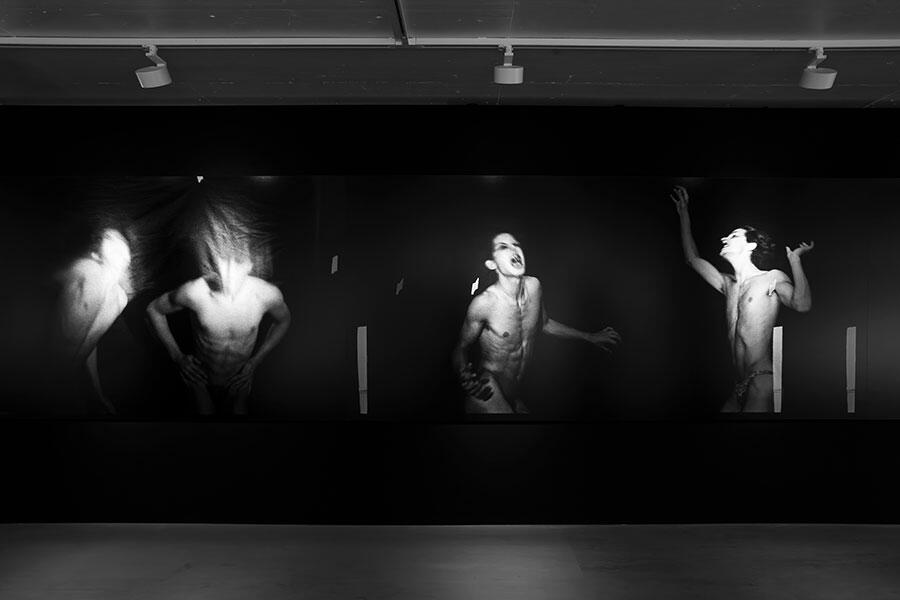
At the centre of the first room is The Bitch and Her Dog (1981), presented as a video accompanied by two large-scale photographic prints. Staged on the streets of Lyon on the occasion of the Third Symposium of Performance Art, the work was realized with the German artist Salomé, Castelli’s collaborator in the avant-garde punk band Geile Tiere (Horny Animals), founded two years prior. Wearing heavy geisha-style make-up – faces painted white with patches of blood-red – the two performers adopt roles that are at once theatrical and opaque. One of the men, dressed in blue kimono with wooden sandals and carrying a red umbrella, walks the other, whose body is painted in dalmatian-like black spots. Onlookers appear puzzled; some smile or take photographs, but their reaction seems nervous. Towards the end, ‘the bitch’ feeds ‘the dog’ what appears to be sushi with chopsticks.
Unlike VALIE EXPORT’s 1968 performance Aus der Mappe der Hundigkeit (From the Portfolio of Doggishness), in which she walked artist Peter Weibel on a leash down Vienna’s Kärntner Straße as a pointed inversion of sexist power structures, Castelli and Salomé’s interplay of dominance and submission, loyalty and servitude, is more ambiguous. Here, the dynamic of gender relations is neither fixed nor totally inverted, rather, it is continually refracted through attire, demeanour and public spectacle. Power circulates rather than settles; humiliation and agency are indistinguishable.
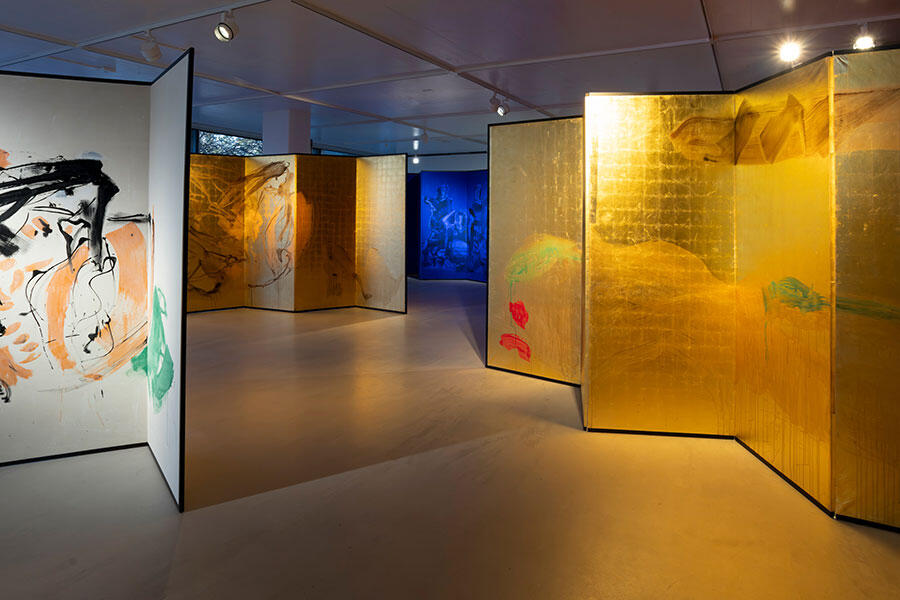
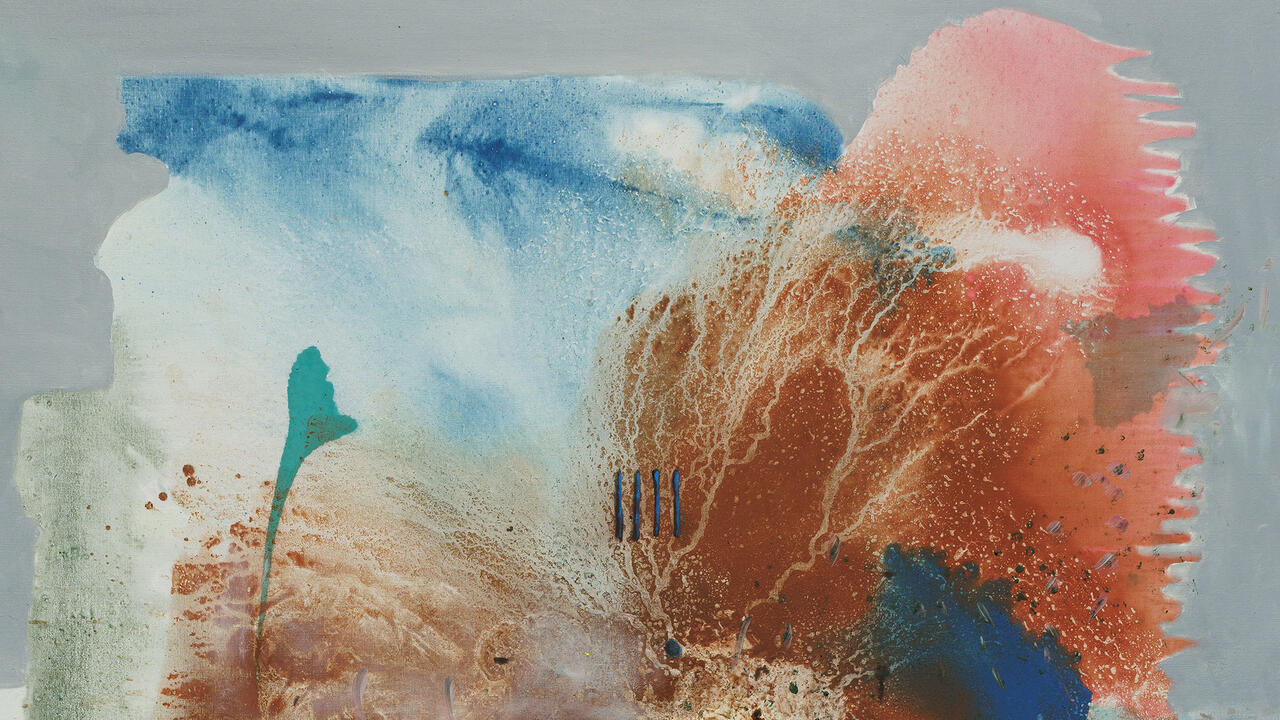
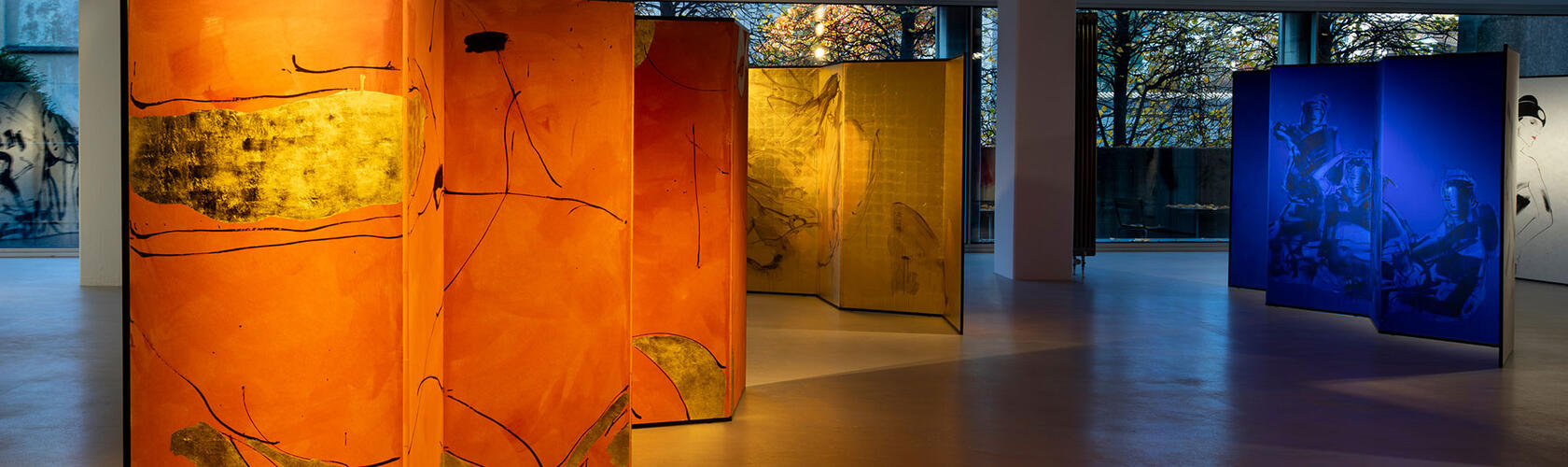
Throughout the exhibition, Japanese references serve less as acts of citation than as tools through which the artist reinvents himself. Scattered across the next room are eight large folding screens (The Japanese Paravents – Byōbu, 2024–25), commissioned specifically for the show. Their monumental structures were crafted in Tokyo and later mounted with over 90 of Castelli’s abstract works, rising taller than a human figure and spanning several metres in width. Painted in broad, gestural strokes on silk and Japanese paper, they emanate intense orange, yellow-gold and cobalt blue, offset by stark black and white. Known as byōbu (wind walls), these objects historically served to divide rooms and spaces; here they emerge as carriers of evocative compositions that unfold across multiple panels.
For Castelli, these landscapes – oscillating between seemingly abstract lines and fleeting human figures – hark back to his early engagement with the neo-expressionist idiom of the Neue Wilde, which emerged in the 1970s and 1980s. This was an aesthetic marked by interest in non-Western forms, bold colours and rapid, broad brushwork, that felt studied yet embraced imperfection. Above all, they all seem to echo the artist’s representation of themselves as a person in flux. Presented nearby is Dogs/Self-Portraits (1981), a massive canvas in dense patches of blue, black, red and yellow. Possibly the most abstract in this constellation, it offers no recognisable shapes or figures, yet its title suggests otherwise, drawing the painting back into Castelli’s ongoing project of self-mythologisation.
Circling between earlier and recent works, ‘Whispers of Japan’ captures the essence of Castelli’s practice: a self-portrait that is constantly morphing. Surrounding the folding screens are large, untitled works painted directly onto the gallery walls in rough contour and bleached grey, producing fleeting outlines of a face from what seems a placid mountainous landscape. If Castelli’s work has at times been dismissed as grandiose, this exhibition insists on its coherence: a persistent investigation into identity and gender as something performed, negotiated and repeatedly undone.
Luciano Castelli’s ‘Whispers of Japan’ is on view at Kulturstiftung Basel H. Geiger, Basel, until 15 February
Main image: Luciano Castelli, ‘Whispers of Japan’, 2025, exhibition view. Courtesy: Kulturstiftung Basel H. Geiger | KBH.G