



‘Rays, Ripples, Residue’ Reframes a Decade of Emirate Art
A survey at Abu Dhabi’s 421 Arts Campus unfolds into an idiosyncratic portrait of the UAE’s contemporary art scene, shaped by influence, informality and heat
A survey at Abu Dhabi’s 421 Arts Campus unfolds into an idiosyncratic portrait of the UAE’s contemporary art scene, shaped by influence, informality and heat
For those unfamiliar with the UAE’s contemporary art scene, a pile of rocks might seem like an underwhelming opening to ‘Rays, Ripples, Residue’, an exhibition dedicated to the last decade of the country’s cultural production. For others, Fresh and Salt (2015) – comprising freshwater stones from the Caspian Sea and coral from Khorfakkan, bound together with copper wire – is instantly recognizable as a key piece of land art from the region. Created by Mohamed Ahmed Ibrahim, a member of ‘the five’, the group of Emirati artists who introduced conceptual art to the UAE in the 1980s, the work’s inclusion functions as both homage and red herring – momentarily suggesting a traditional survey exhibition before giving way to something much more creative.
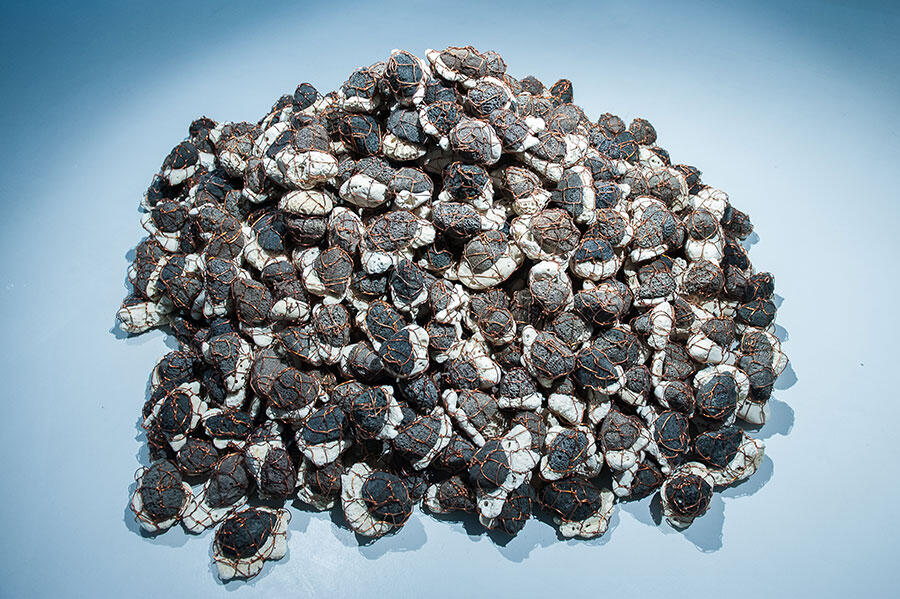
Fresh and Salt opens the first of three distinct sections, each organized by a different local curator. Abu Dhabi-based Munira Al Sayegh’s contribution, ‘Leading to the Middle’, proposes spheres of influence between Ibrahim, the late Kuwaiti Palestinian photographer Tarek Al-Ghoussein and a younger generation of artists working in the region. Fresh and Salt, for example, is placed alongside dense pen drawings of the sea by Latvian-born, UAE-based Adele Bea Cipste (such as Untitled [Seascape 1, Abu Dhabi], 2022), subtly suggesting that the current focus on ecology among Gulf-based artists and institutions was made possible through Ibrahim’s foundational experimentation.
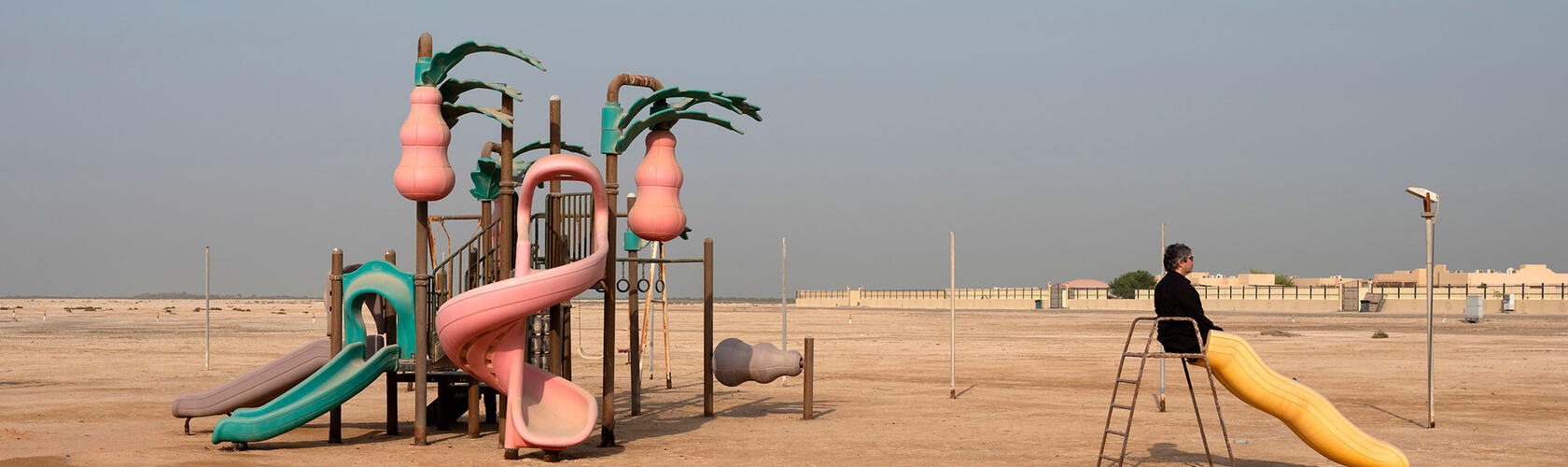
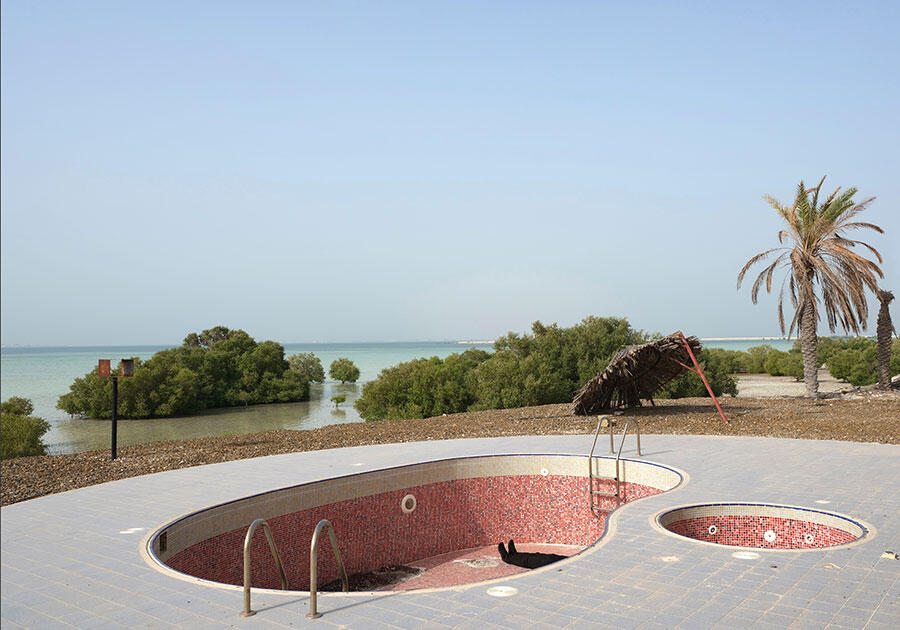
While Ibrahim’s legacy is most readily legible through material and environmental concerns, Al-Ghoussein’s influence emerges through questions of place and belonging. On display are works from his series ‘Odysseus’ (2015–22), in which the artist photographed himself in staged scenes across a number of the emirate’s more than 200 islands. There’s an absurdity to these images: in one, he lies in an empty, kidney-shaped pool with only his legs visible to the camera (Abu Dhabi Archipelago [Jubail], 2015); in another, he mounts a yellow playground slide, his adult body far too large for the plastic frame (Abu Dhabi Archipelago [Ramhan], 2015).
Nearby photographic works by students and friends of Al-Ghoussein lack his deadpan humour but similarly attend to Abu Dhabi’s built environment. For Khaled Esguerra’s series ‘1501, 308 Al Hisn Street’ (2025), the artist documents his recently vacated apartment on Al Hisn Street. As with Al-Ghoussein, Esguerra’s body is the only signifier of life in an otherwise empty landscape.
If ‘Leading to the Middle’ suggests the interconnectedness of the UAE’s still nascent contemporary art scene, ‘Ghosts of Arrival’ – curated by Dubai-based writer and curator Nadine Khalil – confirms it. Al-Ghoussein appears again, but this time in a supporting role: his documentation of objects left behind in a Kuwaiti housing complex prior to its destruction (such as SS 9920, 2015–16), shown in the 2018 exhibition ‘Bait Juma’ (House of Juma), is included as a reference point for this section on self-initiated, artist-led projects. For Khalil, that show – co-curated by Hashel Al Lamki and the Bait 15 initiative, staged in the latter’s artist-run house and featuring members of the Juma family, most of whom no longer make art – represents a time of artistic risk-taking before the proliferation of government-funded institutions dedicated to contemporary art.

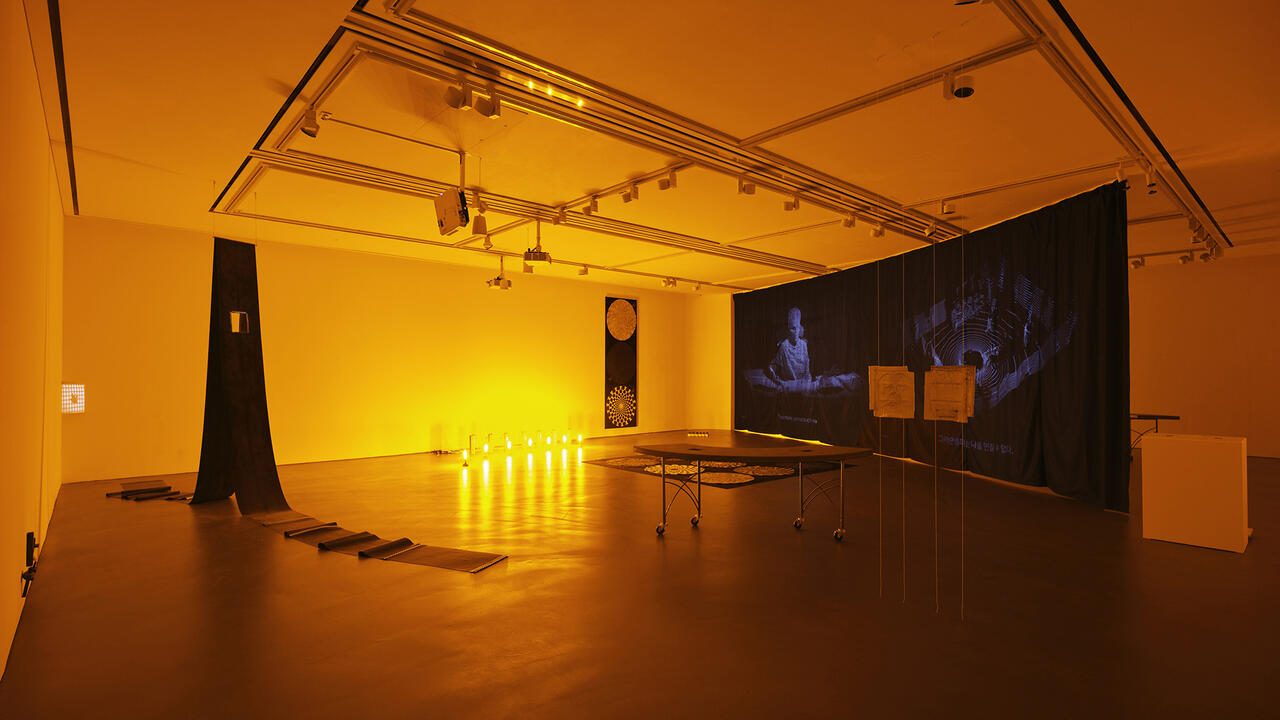
Although her section includes a vitrine containing handmade invitations to the various projects presented here, Khalil avoids historicizing these endeavours. Instead, she critically reconstructs them, allowing for curatorial interventions that echo the spirit of experimentation whose disappearance she laments. Alongside works first exhibited at ‘Bait Juma’, for instance, is a curtain printed with a photograph of the Juma family and artist Isaac Sullivan, taken by Al Lamki. The translucency of the fabric, paired with the blue tinge of the print, evokes the ‘ghosts’ of the section’s title – a metaphor that, for Khalil, represents the feeling of arriving somewhere only to feel that its most vital moment has already passed.
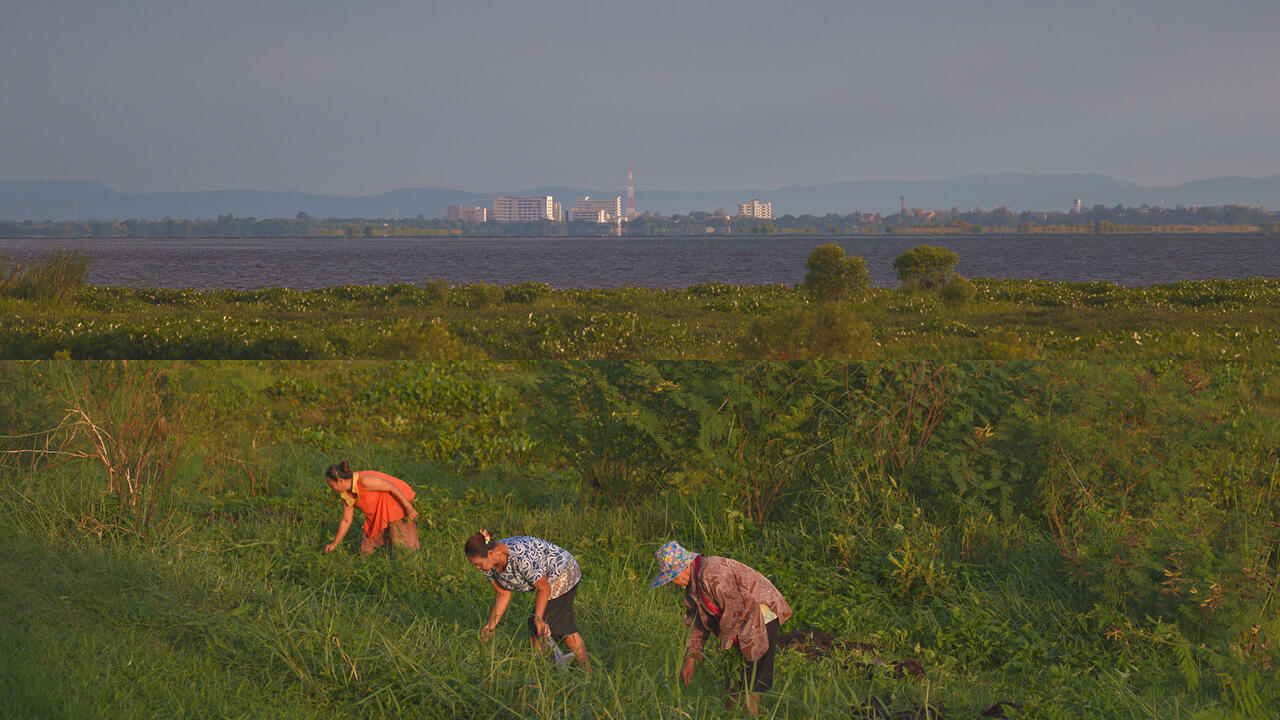
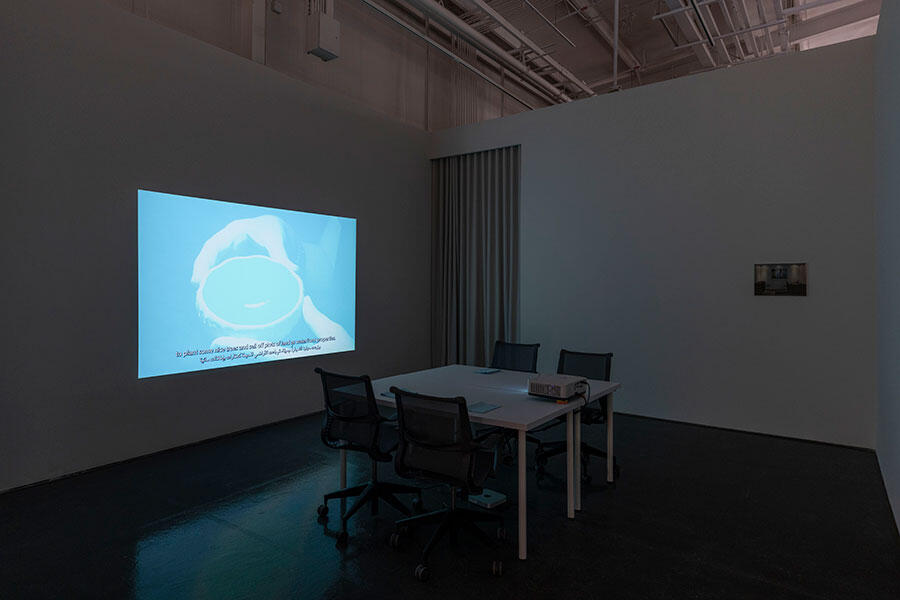
While ‘Bait Juma’ forms the kernel of this section, the other projects – including an artist-curated show in a restaurant and a series of day-long exhibitions in rented office spaces – are no less interesting. The latter initiative, ‘Office Run’ (2018–19), organized in Dubai by Mona Ayyash and Nadine Ghandour, is represented here by the new commission Partial Sea View (2025). A lyrical video essay about the longing for blue and green space, it is shown within a replica of a conference room, complete with swivel chairs and grey partition walls. It’s perhaps telling that both artists went on to work at Dubai institutions (Ghandour at Jameel Arts Centre and Ayyash at Zayed University) – a reminder that independent projects such as these are by nature precarious and short-lived. That they are granted a second life here amounts to a quiet rebellion against how quickly these projects slip from view.
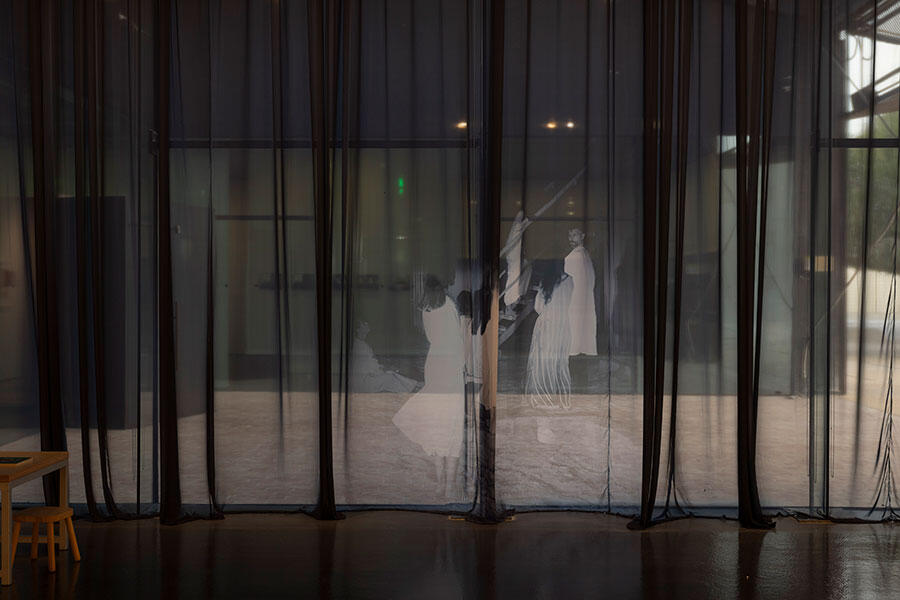
Sullivan). Courtesy: the artist and 421 Arts Campus, Abu Dhabi
If the first two sections require detailed knowledge of the Emirati art world to fully untangle all the references and connections, the last – titled ‘SUN™’ and organized by New York and Sharjah-based critic and curator Murtaza Vali – is easy to understand for anyone who has set foot outdoors. My job is to look at the sunset (2023/25) – an entertainingly low-effort, delegated performance by Khalid Jauffer – sets the tone. For the piece, the artist agreed to take a daily iPhone photograph of the sunset for the duration of the exhibition – an easy task in Dubai but far less certain from his base in famously rainy London, which risked violating his contract.
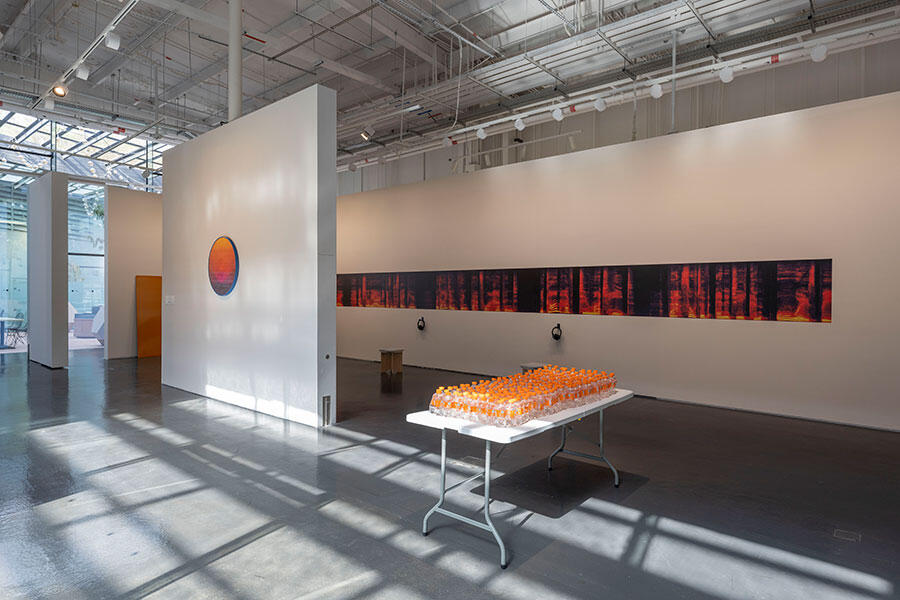
Other pieces similarly find humour and inspiration in the reliability of the weather in the UAE. Lantian Xie’s SUNSHINE (2018) is a collection of identical water bottles arranged in rows on a trestle table. With their orange labels and lids, the display has a cheerfulness that masks a veiled critique of the consumerist nature of the artist’s native Dubai: the product boasts added vitamin D, an absurdity in a region where the sun is omnipresent. When this piece was first shown at Grey Noise, Dubai, in 2018, visitors consumed several bottles of water, mistaking the work for a hospitality table. Since then, the plastic has warped from exposure to heat, unwittingly turning the piece into a comment on capitalism’s contribution to climate change.
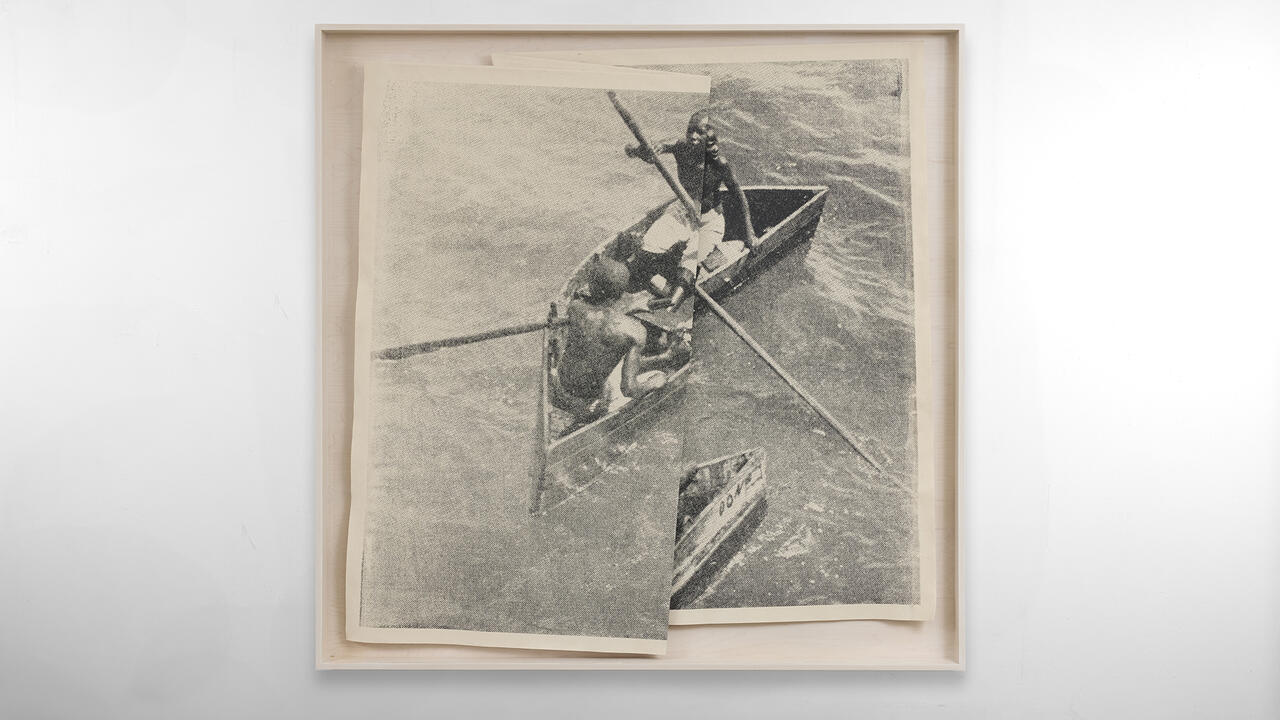
While our warming planet already affects us all, it is of more immediate concern to those who live in the UAE, which today experiences temperature highs in the mid-40s Celsius. Several of the works in this section hint at this concern: Charbel-joseph H. Boutros’s Birthday (2016), for instance, comprises a sheet of bleached-out newspaper onto which the artist has ‘printed’ his name using UV rays of the sun in Dubai. This, combined with the deep oranges and pinks of Nima Nabavi’s round ink drawing Source Code (2025), is enough to encourage even the most blasé visitor to reapply high-factor sunscreen before leaving the exhibition.
It is notable that ‘Rays, Ripples, Residue’ coincides with the tenth anniversary of 421 Arts Campus, one of the few independent spaces in Abu Dhabi, at a moment when the city’s cultural landscape is rapidly expanding around Jubail Island. Rather than positioning itself against these mega developments, the exhibition gestures towards another way of engaging with history – one that values attentiveness over monumentality. If the forthcoming Guggenheim Abu Dhabi will likely offer an encyclopaedic forward march through the region’s art history, ‘Rays, Ripples, Residue’ instead embraces flânerie: a personal, intuitive amble through the recent past that unsettles rather than crystallizes the canon.
‘Rays, Ripples, Residue’ is on view at 421 Arts Campus, Abu Dhabi, until 26 April
Main image: Tarek Al-Ghoussein, Abu Dhabi Archipelago (Ramhan), 2015, digital print 60 × 80 cm. Courtesy: the artist and The Third Line, Dubai